
|
Features
You are here
Santa Marta conference charts path toward climate justice from below
June 7, 2026
In November of last year the United Nations had the dubious honour of marking its 30th “Conference of Parties” (COP), the annual meeting of signatory nations to the 1992 United Nations Framework Convention on Climate Change (UNFCCC). The meetings began in 1995, following a tumultuous prior decade that saw both the establishment of the Intergovernmental Panel on Climate Change (IPCC)to assess the state-of-the-art science of the Earth’s climate and guide global policy, as well as the collapse of nascent international negotiationson climate action due to malicious interference by members of the Bush Sr. administration.
Two years later, at COP3 in 1997, the Kyoto Protocolwas signed, the first major international agreement on carbon emission reductions. Even at this early stage, however, there were cracks that hinted at future impasses, such as US-mandated concessions to exclude its massive military emissionsfrom carbon budget accounting. The Paris Agreement in 2015 further cemented the low bars achievable under the UN consensus mechanism: while signatories to the UNFCCC made a commitment to keeping the Earth’s average temperature from exceeding 2°C above pre-industrial levels, and ideally limit it to 1.5°C, no clear strategieswere put in place to achieve this goal, nor consequences delineated to ensure compliance.
So where did these parties find themselves last November, as they descended upon the lush rainforests of Belém, Brazil? The outlook was bleak: in 2024, scientists determined the Earth had reached a yearly average temperature of 1.5°Cfor the first time, and the trend of increasing anthropogenic carbon emissions showed no sign of even slowing down, let alone reversing.
COP failures
In the decade since the Paris Agreement, COPs have become something of a joke, transparent bully pulpits for petrostate host countries to keep the world hooked on oil while slicking themselves in the thinnest coat of greenwash imaginable. They were also open markets for major companies to do the same, exerting significant influence over the negotiations even though they technically only attended as “observers”. At COP28 in Dubai over 2,400 fossil fuel lobbyistswere present, outnumbering delegates from almost all individual nations, and an acknowledgement of fossil fuels as the driving force behind climate change was only included in the final text for the first timeat COP26 in 2021.
Last year there was not just a failure to make progress, but a veritable backslide: the words “fossil fuels” appeared nowhereat all in the final agreement.
In the midst of this frustrating impasse, two nations—Colombia and the Netherlands—decided it was time for the gloves to come off. Towards the end of COP30, when it was clear negotiations were once again stalling, they released a joint announcementfor the first “Conference on Transitioning Away from Fossil Fuels”(TAFF) to be hosted in Santa Marta, Colombia in April of this year. Notably, they extended invitations only to “coalition of the willing” states identified as committed to real climate action, and excluded the United States, Russia, China, and other major fossil fuel-producing countries that have historically torpedoed international collaboration.
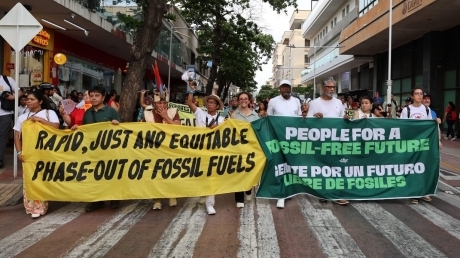
That conference has now transpired, and there are promising signsthis was not just another cushy vacation for world leaders to hem and haw over word choices and phrasing. Alongside the traditional meeting of government representatives, for the first time the process included both a science pre-conferenceand an independently-organized People’s Summitthat brought in representation from Indigenous peoples, grassroots environmental networks, feminist organizations, trade unions, and civil society groups.
Together, these satellite meetings resulted in two important documents that directly influenced the outcomes of the conference: 1) a scientific “action report”distributed to governments ahead of the conference that made concrete recommendations for what must be done to get off fossil fuels (something the IPCC is explicitly prevented from doing); and 2) a declarationpresented at the "Peoples' Assembly" on April 27 that outlined core principles for a just transition.
The language in these reports was clear, direct, and unambiguous. The science action report states that governing bodies must “ban new fossil infrastructure, mandate deep methane cuts, accelerate electrification and inscribe fossil-fuel phase-down targets”, while the Peoples’ Declaration is even more overt, naming as the root causes of the climate crisis “a global system rooted in capitalism, colonialism, racism, patriarchy, class and caste systems, imperial domination, and white ‘supremacy’ which are characterized by inequality, exploitation, extraction, expropriation and extermination.”
Climate justice from below
The Peoples’ Declaration made four key demands:
- A complete, equitable, and just phase-out of fossil fuels aligned with meeting the goal of keeping warming below 1.5°C, reaching true zero global emissions by 2050
- A rapid, direct, equitable, and just transition to 100% renewable energy with universal and equitable access
- An end to barriers to transition and committed pursuit of solutions; and
- A comprehensive and just transition.
Then came the final two days of the conference, dedicated to the more traditional “government negotiation”-type programming, where these roadmaps and declarations would inform discussions towards action by all participating states. Unlike the traditional COP atmosphere, however, these talks took the form of smaller, more informal “closed-door” breakout sessions where contributions were kept anonymous in the official record, and both government representatives and civil society stakeholders were given equal opportunity to speak. At the end of the high-level summit, Colombia and the Netherlands produced a summary of the talksand identified key “workstreams” to tackle before the second conference, to be jointly hosted by Ireland and Tuvalu in 2027.
Although Santa Marta did not produce a binding agreement to end fossil fuels, it was still a major breakthrough towards achieving that goal. The Fossil Fuel TreatyInitiative, who organized the conference, has sought to implement such an internationally-binding treaty since 2020, heeding demands made by the island nations most vulnerable to warming-induced sea level rise since even before the 2015 Paris Agreement. This “fossil fuel non-proliferation treaty” would be a direct parallel to the 1968 UN Treaty on the Non-Proliferation of Nuclear Weapons, which—while significantly flawed, and often used as a tool of control and domination by existing nuclear-armed states—would at least accurately reflect the potential for death and destruction wrought by continued fossil carbon extraction, and the immediacy with which action to stop it is needed.
Familiar fossil faces
Given the universally acknowledged risks of such planet-imperiling practices (what Colombian president Gustavo Petro called a “suicidal model of capitalism”), the presence of certain countries at the first TAFF may have raised a few eyebrows. Canada, Australia, Brazil, and Norway, collectively representing 10% of the world’s oil and natural gas production, were all proudly in attendance. Canada in particular was an egregious outlier among the assembled parties: it ranks 4th and 5th in global oil and gas production, respectively, while its per-capita carbon emissions exceed even those of the US. And, true to the songbook being rapidly composed under the Carney government, Canada was the only nation with nary a whistle of the “f-words” in its opening remarks at Santa Marta.
The contradictions inherent in Canadian participation in a meeting premised on ending the production and export of oil and gas are painfully obvious. That there were government representatives at a conference with getting “away from fossil fuels” in its very title, just weeks before deals were announced for a new oil sands pipelineas well as newand expandednatural gas infrastructure, should be a permanent stain on Mark Carney and the Liberals’ reputation.
Carney, who just a few years ago stated it was an “absolute imperative”for the world to reach net zero, has now gone all-in on a gas-powered national electricity gridwhile pointedly demurring on whether Canada can still meet its 2030 Paris emissions targets. It’s no wonder why an ex-environment minister left his cabinet amid a chorus of MPs speaking outagainst his climate backpedalling: even the neoliberal governing party can’t stomach the hypocrisy. If Canada intends to meaningfully participate in future TAFFs, we will need to push heavily for a grassroots response to force the government to live up to its commitments, alongside supporting Indigenous peoples, youth activists, and trade unions as key parties in the negotiations.
Ultimately, solving the massively complex problem of climate change will take more than convivial gatherings of nation-states and textual declarations; it will require a real, sustained, and transformative revolution in how our societies operate at their most fundamental levels. But Santa Marta represented a turning point where stifled old frameworks and endless bureaucratic obstructions were finally cleared away, leaving space to imagine a truly just and sustainable future. Gone are the days of blissful capitalist ignorance to the “externalities” foisted upon the planet in pursuit of profit. The world has woken up, and it is starting to speak back. It’s time we heed the call of comrades at the forefront of this new climate battleground and, in solidarity, join the fight.
Section:


Featured Event
Events
-
October 4, 2026TorontoOrganized by:International Socialists
Recent Videos


Visit our YouTube Channel for more videos:

Visit our UStream Channel for live videos: