|
Reports
You are here
Montreal students confront the guardians of austerity
November 16, 2026
“I’m afraid I won’t be able to cope anymore.” That is how nursing student Karry-Ann described her situation to the Journal de Montréal. She works thirty hours a week across three jobs, takes eight courses, and faces an unpaid placement. Behind those words is a life worn down by study, work, and rent, and the fear that simply carrying on will become impossible. She joined the demonstration on Friday, November 13, to defend her right to an education without being crushed by the struggle to survive.
That same day, the newspaper documented protesters being struck by police projectiles, people being beaten as they tried to leave, and a woman receiving first aid after collapsing. It also witnessed an officer approach clearly identified photojournalist William Wilson and pepper-spray him at close range.
The nature of this confrontation emerges in the distance between a student struggling to continue her education and police firing tear gas at demonstrators. Demands for food, housing, and pay for work are met by an institution empowered to disperse and hurt those making them. Whose “security” is being protected when young people pay for defending their future with their bodies? What kind of stability deserves protection when it rests on exhausting tomorrow’s nurses, teachers, and social workers?
Batons defend profits
This repression exposes the class function of the police. They are part of a state that protects a system of property and profit, preserving relationships that give a minority control over wealth while leaving the majority burdened with work and debt. When those bearing the cost try to disrupt that system through strikes or by taking over the streets, the force behind an allegedly natural and neutral order comes into view.
Individual poverty can be ignored. Poor people organizing together becomes a political problem. As long as a student wears themselves out juggling three jobs and their classes, life carries on “normally.” When they join others in refusing that exhaustion, the machinery of restoring order moves into action. For the landlord, this return to “normal” means collecting rent as usual. For Karry-Ann, it means returning to the fear that drove her into the streets.
No business owner needs to issue orders to each police officer for this relationship to function. It is rooted in the structure and priorities of the state: preserving a society governed by the interests of capital and containing resistance from those who bear its costs. Police violence therefore raises questions that go beyond the conduct of individual officers, however brutal, to the power they exercise and the system they defend.
Hunger in the classroom
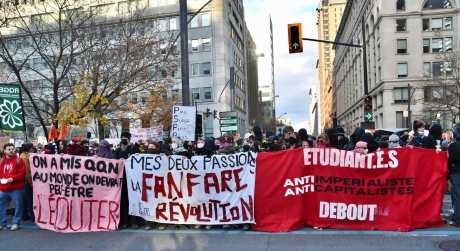
Around 100,000 students across Quebec were on strike on Friday, according to an estimate from the Coalition de résistance pour l’unité étudiante syndicale (CRUES), reported by La Presse. Thousands joined the Montreal march. Students are demanding financial aid reform, paid placements, and renewed investment in education. These are basic demands, yet they collide with a logic that treats education as an individual investment, poverty as a personal responsibility, and unpaid work as a stage everyone is expected to endure.
Pierre, a social work student, told Pivot that he must complete a placement requiring twenty-one hours a week. To get through it, he has to take on more paid work beforehand to save money, on top of his studies. He is learning to help others while being asked to push himself to the limit just to enter the profession.
Julie says she can keep going because she lives with her parents and receives their support. But she sees that advantage, unavailable to everyone, as a reason to stand in solidarity. Her position captures something essential about the movement: surviving individually does not make the conditions of life fair. What family support makes possible for one person should be a right available to all.
Unpaid placements embody profound class and gender injustice. Society depends on care, education, and social work, yet makes unpaid labour a condition of training for these fields. In doing so, it reproduces the devaluation of care work, so much of which falls to women. Family resources become a hidden condition of entry into a profession. The path becomes longer and more exhausting for working-class students, particularly those also supporting children or caring for relatives.
Hunger is woven into these lives. An overview of findings from the Quebec Student Union’s 2024 survey showed that 40 percent of respondents had experienced at least one of the situations used to measure food insecurity. The proportion rose to 46 per cent among financial aid recipients, while 16 per cent of those recipients reported going an entire day without food because they lacked money.
Behind these percentages are people trying to concentrate on empty stomachs, their education overshadowed by anxiety. When financial aid cannot ensure that its recipients have enough to eat, poverty becomes part of the conditions of education itself. Society opens the university doors, then leaves many students struggling alone to stay inside.
This crisis reaches into working-class homes across Quebec. According to the Institut du Québec, overall prices rose by 18 per cent between January 2022 and July 2026, while housing costs rose by 27 per cent and food costs by 24 per cent. Between 2022 and 2025, real disposable income fell for the poorest 40 per cent of households, remained roughly unchanged for the next 40 per cent, and rose for the wealthiest 20 per cent. The overall average can improve while life becomes harder for those with the least.
A comparison with 2019 does show real income rising across all income groups: exceptional support in 2022 raised the starting point for the later comparison. But that does not erase the subsequent decline among poorer households. Nor does slowing inflation bring down grocery bills or restore rents to their previous levels. People spending their last dollars on necessities need the means to buy them, not an announcement that prices are rising more slowly.
In October, Quebec’s food bank network reported meeting 3.27 million requests for assistance each month, an increase of 44 percent over five years, while serving around 600,000 distinct individuals monthly. Among households receiving assistance, the share whose main source of income was employment rose from 20.6 to 23.4 percent in a single year.
These are repeated requests for assistance, not millions of different people. But they reveal a harsh reality: having a job does not guarantee freedom from hunger. People sell their time and labour, then have to queue for assistance to eat. This is the society students come from and return to after class.
The movement therefore raises a question far larger than whether it represents Premier Paul St-Pierre Plamondon’s “first crisis.” At stake is the ability of students and workers to force the right-wing Parti Québécois government to retreat and refuse to carry the cost of austerity. On November 12, Higher Education Minister Elsie Lefebvre reaffirmed the government’s commitment to paying for placements in public-sector fields but would not say whether this would happen before the next academic term. While students wait for government timelines, rent keeps coming due and unpaid work continues.
Quebec remembers how to resist
Quebec’s students bring a long history of struggle to this confrontation. In the autumn of 1968, students at fifteen CEGEPs and some students at the Université de Montréal went on strike, demanding wider access to university, better financial aid, a tuition freeze, and a say in how education was organized. The movement emerged amid the expansion of public education during the Quiet Revolution, pushing reform forward through organization and pressure from below.
In 2005, a mass strike challenged the conversion of $103 million in grants into loans and forced the government to back down. At its heart were general assemblies where students debated, voted and organized participation. They learned that collective decision-making gave them a power they did not possess alone, and that a government financial decision presented as final could be overturned when they refused to accept it.
Then came the spring of 2012. The struggle began against a planned tuition increase of roughly 75 per cent over five years and grew into a confrontation over education, democracy and state power. The government responded with the emergency legislation known as Loi 78, police kettling and mass arrests. The Ligue des droits et libertés documented 3,509 arrests between February 16 and September 3, including thirty-one mass-arrest operations. The official inquiry also confirmed the widespread return of kettling and mass arrests.
Students didn’t fight alone: working class communities across Québéc joined student demonstrations to defy Loi 78, organized neighbourhood assemblies to build support, wore “carré rouge” patches in solidarity and held “Casserole” protests each night. The movement as a whole was a major factor in the fall of the Liberal government in the autumn.
Today’s images of repression therefore evoke more than a memory. They bring back into focus the relationship between a government determined to impose its social policies and an institution equipped to break resistance. At the same time, the memory of 2012 carries knowledge forged in the streets: mass mobilization can overcome isolation, turn individual fear into collective courage and force those in power to retreat.
History also carries a warning. Pauline Marois’s Parti Québécois government cancelled the Liberal tuition increase after the 2012 election, then adopted income-linked tuition indexation in 2013. Cancelling the increase was a victory won by the movement; the policy that followed exposed the limits of relying on a change of government. Suspending organizing while waiting for the goodwill of those in power weakens the very means by which victories were won.
The struggle continued against austerity in 2015, then through strikes demanding paid placements in 2018 and 2019. Its scope expanded: from entering university to having the means to remain there; from the cost of studying to the exploitation of student labour; from defending education to questioning how society itself is organized.
From Montreal to Europe
Today, that experience resonates beyond Quebec. Alice Lemieux, a comparative literature student at the Université de Montréal, told La Presse about the inspiration she drew from protests in France and her opposition to the commodification of education. She warned that images of confrontation could eclipse the demands that brought students into the streets.
It is an understandable fear: that the life of a hungry student will disappear behind an image of a clash, and that someone asserting a right will become a suspect expected to justify protesting.
In recent weeks, France has seen widespread university and high-school student mobilizations in Paris and other cities, alongside campus and school blockades and defiance of protest bans. The student and labour movements have come together against the rising cost of living and austerity. Across the Atlantic, young people in Montreal recognize their own anger in that movement and draw encouragement from its determination.
In Italy, tens of thousands of students and workers took to the streets on October 30 against rising living costs, inadequate services, and increased military spending. In Genoa, around 15,000 dockworkers, students, and other supporters entered the port. This convergence demonstrates the possibilities of moving beyond the campus: when student anger connects with workers’ power to stop production and transport, their protest breaks out of isolation and gains the capacity to win their demands.
Serbia offers a different experience. The collapse of the canopy at Novi Sad railway station, which killed sixteen people, ignited a protest movement that grew until a student-backed bloc won October’s election, according to Reuters. Grief became organization and anger at an administration protesters held responsible for corruption. Despite the different circumstances and the limits of electoral change, the experience shows that a student movement can break through an entire society’s sense of powerlessness.
Towards a strike to break austerity
In Quebec, the demonstration on Friday, November 20, and the coalition’s extraordinary congress on November 21 can raise the prospect of an unlimited general student strike. As of November 15, this remains a process of debate, voting, and preparation.
What this prospect amounts to will depend on the collective strength built around it. A strike needs broad general assemblies and elected, accountable committees. It also needs food, solidarity funds, childcare, and support for those arrested. These are the conditions that enable people living on the edge of poverty to participate and keep going. A movement fighting for a decent life must practice solidarity within its own ranks so that struggle itself does not become a privilege reserved for those who can afford it.
Trade unions must turn support into practical commitments decided by their rank and file: delegations to picket lines, solidarity funding, joint meetings, and preparations for wider action. The student workers’ union at the Université du Québec à Montréal has already endorsed the demands and linked conditions of study to conditions of work. That connection can become the foundation of a broad social alliance confronting austerity and repression together.
This also means widening the movement to include international and immigrant students and both French- and English-language institutions. Every attempt to use the defense of language to divide people facing rising prices and exploitation must be challenged. A Francophone student and their immigrant classmates share an interest in accessible education, secure housing, and a living wage. The movement grows stronger when it organizes around those common interests and challenges the policies that serve the ruling class and the wealthy.
Confronting police violence is part of this struggle: documenting assaults, holding those responsible accountable, collectively defending the right to protest and strike, and refusing to abandon those subjected to repression. The movement’s strength lies in making an attack on a student or journalist a concern for workers, neighborhoods, and unions, and turning attempts at intimidation into reasons for solidarity to grow.
Karry-Ann wants to become a nurse without breaking down before she reaches the profession. Pierre wants to learn to help others without being consumed by unpaid work. In these two simple demands, individual futures meet the future of society. Who will care for us and teach our children if the path into these professions runs through hunger, exhaustion, and debt?
Here lies the possibility of a movement reaching far beyond the universities, defending people’s right to their time, their bodies, and their futures. A movement that refuses to let the working class be drained so that wealth can keep accumulating and then be beaten with batons when it objects.
The police guard a system that wants each of us to carry our fear alone. The challenge to that system begins when fear becomes solidarity, solidarity becomes organization, and organization becomes a strike that puts people’s lives first.
Section:
Topics:


Featured Event

Recent Videos


Visit our YouTube Channel for more videos:

Visit our UStream Channel for live videos: