|
Reports
You are here
Spain’s housing strike, born of politics from below
November 14, 2026
Spanish workers and tenant organizers have won a partial victory after Wednesday's general strike, showing the power of popular mobilizations to drive real change.
What is a strike? Who should call one? Who is it aimed at? These three questions have been at the heart of the debate among traditional trade unions, politicians of every stripe, employers’ organizations, and the Sindicato de Inquilinas (the Tenants’ Union), the driving force behind the general strike called for 11 November across Spain. While it is not, as has been claimed, quite the first general strike called in Spain in 14 years, it is distinctive in one respect – it is a strike that has grown out of anger and grassroots organizing around the housing crisis, and has earned the full backing of the major trade unions and even of the progressive coalition government in power.
The spark that set off an intense popular uprising, including demonstrations that shut down major thoroughfares in Madrid and Barcelona at the end of September and permanent encampments that occupied the centres of more than a dozen Spanish cities for a month, was the eviction of Maricarmen. An 87-year-old woman with a 50% disability, she lived in a central Madrid neighbourhood and had spent eight years fighting a speculative fund that bought her home and tried to force her out by raising her rent by more than 300%.
Urbagestión Desarrollo e Inversión S.L. filed a criminal complaint against the Madrid Tenants’ Union for publicly calling it a “vulture fund”. Yet the company’s conduct appears to fit that label precisely: buying housing to profit from rents or resale at exorbitant prices, exploiting lax legislation and a housing market strained by tourism; imposing abusive rent hikes to push tenants out of their homes; evicting people without offering them a decent alternative, with the connivance of a city council that abdicates its responsibility to mediate in evictions; and disregarding the legal protections against eviction that certain vulnerable groups enjoy. Her case is a textbook example of the housing situation in Spain.
But Maricarmen did not suffer in silence or retreat into private life. She joined activist support networks that not only helped her stand up to her new landlords but also empowered her and made her part of a wider struggle against what Spain’s housing movement has identified as the rentier system. Under this logic, housing is treated as a commodity rather than as a fundamental right, and speculation and profiteering are left largely free of legal constraints. The result is that housing has accumulated in the hands of large-scale property owners, at the expense of tenants and the public housing sector, deepening inequality between owners and tenants.
Before she died on 7 October in the public hospital where she had been admitted after her eviction, and before popular mobilization managed to force Urbagestión to negotiate her return home at her previous rent, Maricarmen said: “I didn’t succeed in defending my home, but I did succeed in fighting so that others learn to fight for theirs. My home was my life and now I have to leave it behind, but that doesn’t mean I’m going to stop fighting. I want to thank everyone, the children who came to my eviction and the friends from the Sindicato de Inquilinas who are now like a family to me. Fight, defend what is yours.”
And it was from the outcry of the people who put their bodies on the line to stop Maricarmen’s eviction, who demonstrated tirelessly in the weeks that followed, and who camped and held assemblies in the Puerta del Sol and in so many other squares, that the initiative for this general strike emerged, as a tool for doing politics from below. Popular outrage looked for ways to force the progressive coalition government to act on its declared intentions to curb property speculation, intentions that were slow to materialize and, to many, seemed never likely to. As Alicia del Río, spokesperson for the Sindicato de Inquilinas, explained: “A ballot paper in an election is not going to solve the housing problem. We need a strong popular power in order to win rights.”
The strike call was made almost at the same time as the call for elections. Popular unrest forced the government to put forward two decrees against property speculation, which Congress rejected. Whether because the prime minister, Pedro Sánchez, recognized that the progressive coalition could not implement the social measures it wanted without an absolute majority in Congress, or because he hoped to benefit electorally from a moment when the right, both pro-business and nationalist, was siding openly with large landlords and speculative capital, he called elections for 29 November. On 12 November, with parliament dissolved for elections, the Permanent Deputation, a body with a different makeup from the full chamber, validated the less ambitious of the two decrees, which includes measures limiting speculative purchases of housing by vulture funds.
Thus, this strike has been called to put pressure on a progressive government that has failed to stand up to property speculation forcefully enough, but it also exposes the right-wing opposition, which has consistently sided with employers and rentiers. It adds to the three-day strike in the meat industry and to the indefinite teachers’ strike that has been under way since 14 October in the Madrid region and in other autonomous communities governed by the PP. The demands of these strikes go beyond wages and also centre on the defence of public services, which are increasingly neglected, particularly in PP-run regions.
Behind these popular struggles lies the idea that inequality is not generated only in the workplace and in wages. The feminist movement had already put this idea forward in the general strikes it called in 2018 and 2019, whose demands concerned living and working conditions beyond wage labour. These demands pointed to deep social transformations, such as ending gender discrimination and inequality and, above all, recognizing the value of the reproductive sphere of work, which is not counted in the wage bill. Like care work, housing is a condition for sustaining life, and robust public services are what allow people to live that life without spending all of it working in an increasingly unequal world.
Right wing parties, the PP and Vox, as well as various employers’ organizations, have tried unsuccessfully to denounce this strike as illegal on the grounds that it is supposedly driven by “political and ideological motivations”. But the Spanish Constitution recognizes the right to strike as a fundamental right whose purpose is the defence of workers’ professional, economic and social interests, broadly understood. Alberto Núñez Feijóo, leader of the right-wing opposition Partido Popular (PP), called the strike “preventive” and a “disguised election campaign event”, but that claim has no constitutional basis and only shows how unable, or unwilling, bourgeois politicians are to understand the people’s struggle.
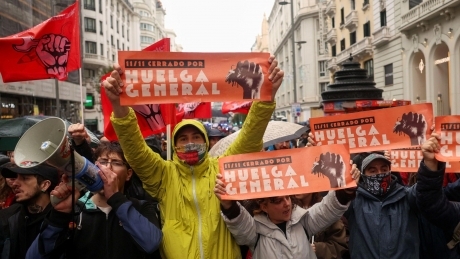
The Tenants’ Union worked to mobilize support for the strike in every neighbourhood and workplace, not only through its assemblies but also through a purpose-built online platform created by its activists to map and coordinate mobilizations, pickets and strike committee activities. According to the unions, participation in the general strike ranged from 41% to 75%, depending on the region. From the early hours, there were pickets at wholesale food markets in major cities such as Madrid and Seville and at industrial estates in Toledo and León. The strike was widely observed in industry, but much less so in hospitality, a highly precarious sector with low union membership. Motorways were blocked in Catalonia and Madrid, and more than 300 flights and a quarter of long-distance trains were cancelled. Andalusia’s regional television channel went off the air, and protesters interrupted a public television programme with banners in Catalan reading “Making a living shouldn’t cost us our lives”.
Despite torrential rain, the demonstrations at the end of the day drew huge crowds in every Spanish city. In Madrid, the Government Delegation put attendance at around 120,000, while the Tenants’ Union claimed more than 400,000. There were clashes with police at industrial estates and during informational pickets. The police blocked and rerouted marches, performed unjustified identity checks, arrested more than a hundred demonstrators across the country, and indiscriminately attacked demonstrators with batons and pepper spray in an attempt to regain control. Amnesty International Spain has condemned these actions, and Irene Montero, the Podemos candidate who took part in the demonstrations, has called for the resignation of the interior minister, whose ministry bought 70,000 euros worth of pepper spray a month ago. Comisiones Obreras (CCOO), one of Spain’s major trade unions, will file a criminal complaint over the use of pepper spray against peaceful demonstrators in Madrid.
Spain’s recent strike has expressed a deep exhaustion with a precarious way of life, imposed by an economic system that survives only through political complicity. It has embodied a rejection of the privatization of public services, of the cut-throat competition for survival that neoliberal policies foster, and of the treatment of our cities and our lives as raw material for profit. It also has been a rebuff to the simple, reactionary answers of the far right, which blame the most vulnerable and defenceless. And it has been a refusal to accept a world that wants us isolated, shut away in the troubles of our private lives, concerned only with our own wages and interests, blind to the structures behind them, and resigned to not being political actors. It has been a show of strength by the Tenants’ Union and by a popular movement that has been sweeping across Europe in recent months, from Serbia to France and Italy.
Popular struggle has seized the initiative from the institutional channels of representation in liberal democracy, and is now setting the agenda for political debate and action.
Section:


Featured Event

Events
-
November 15, 2026TkarantoOrganized by:International Socialists
-
November 15, 2026TkarantoOrganized by:International Socialists
Recent Videos


Visit our YouTube Channel for more videos:

Visit our UStream Channel for live videos: