
|
Reports
You are here
Taking on the Point Tupper data centre in Nova Scotia
November 10, 2026
Nova Scotia’s wind, water and power grid are being sold to Big Tech.
On October 16, Nova Scotia Premier Tim Houston and EverWind Fuels CEO Trent Vichie announced a $10 billion AI data centre at Point Tupper in Richmond County, presented as the largest private investment in Nova Scotia’s history.
Two Halifax Examiner reporters who have followed EverWind for years were asked to leave the announcement event. The company has since scheduled few public consultations, shutting out critical journalists making it clear that they want to push through without questions. Tim Houston’s office even tried to intimidate a Toronto Metropolitan University scholar who questioned the project, copying his department chair on its email reply.
EverWind plans a 420-megawatt hyperscale campus, built in two phases by 2028, with the first phase leased for 20 years to the American AI company Anthropic to run its chatbot, Claude. The campus would take up to half a million litres of water a day from Landrie Lake, the drinking water source for Port Hawkesbury. In return, the project promises 2,000 temporary construction jobs and 215 permanent ones.
Bailing out EverWind
EverWind bought a fossil fuel terminal at Point Tupper in 2022 and announced it would produce green hydrogen and ammonia through wind farms and export them to Germany. The company secured about $166 million in debt financing from Export Development Canada and $22.5 million from the federal Green Shipping Corridor Fund, on top of $240 million from the US asset manager Nuveen. Then the hydrogen plan stalled, and one of its two German buyers pulled out. EverWind owes money to its lenders and has tied its other projects to the data centre, which puts the province under heavy pressure to say yes.
No legislation, no environmental assessment
Like other provinces, Nova Scotia has no rules written for data centres, and they are not on the list of projects that require an environmental impact assessment. Instead, the data centre leans on approvals EverWind already won for hydrogen projects. When the NDP called for legislation setting protection guarantees, Premier Houston refused. EverWind's answer to the protests is a memorandum of understanding promising to protect power rates and limit water use. That leaves out concerns such as noise, the impact on wildlife, rising lake temperatures and heavy metals leaking into the water. Only a full environmental impact assessment can address those concerns. The Nova Scotia government is actually copying what the federal government is doing on a bigger scale with Bill C-5.
Big Tech on both sides of the medicine line
Data centres are sold to us the same way as pipelines and ports — as nation-building projects that protect AI sovereignty from US dominance and the Trump regime.
But EverWind was founded by Trent Vichie, a New York-based billionaire and Trump supporter, and the leaseholder is Anthropic, an American tech company. The "elbows up" politicians cannot hide the fact that the ruling classes on both sides of the border want the same thing. In province after province, hosting the infrastructure of the AI boom lets Canadian governments sell wind, water, gas and grid capacity to the biggest tech companies, just as they sell oil and gas through pipelines.
The cost of these hyperscale projects falls on working-class and Indigenous communities. In the US, hundreds of protests have targeted data centres that drain aquifers and raise power bills. Here, the Mi'kmaq consortium led by Membertou is a partner in EverWind's wind farms, but it has no part in the data centre. EverWind is now negotiating an Indigenous stake in the project so that it can advertise the project as built on the first nations’ consent.
The AI industry is also deeply tied to militarization. On February 28, the first day of the US-Israeli war on Iran, a US Tomahawk missile killed more than 120 children because of the Palantir's Maven system, which has Anthropic's Claude built into it. Fighting hyperscale data centres means taking on companies that chase trillion-dollar valuations while their technology is reshaping wars with brutal human costs, from Gaza to Iran.
Building the resistance
Within weeks of the announcement, more than 25,000 people signed a petition against AI data centres in Nova Scotia, and protests were called across the province for November 7.
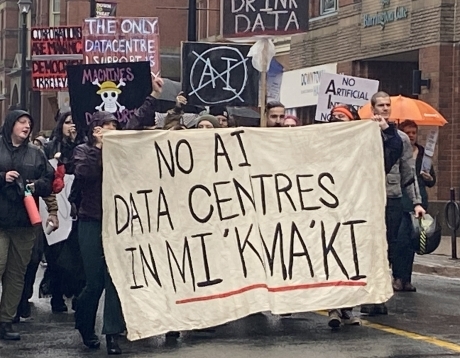
And the demonstrations were huge. Despite heavy rain, thousands poured into the streets of Halifax, Sydney, Port Hawkesbury, Truro and Kentville to protest the proposed centre - rallying behind the banner “No AI Data Centers in Mi’kma’ki.”
That anger has to stay mobilized to stop this project. EverWind is applying for industrial approvals and power contracts, and we can challenge each one and win a moratorium.
The movement against data centres belongs alongside the ongoing struggles against Bill C-39, Bill C-5 fast-tracking, violations of Indigenous sovereignty, militarization and the AI industry's ties to war.
United, we can take back the water, the land and the wind.
Section:
Topics:


Featured Event

Events
-
November 15, 2026TkarantoOrganized by:International Socialists
-
November 15, 2026TkarantoOrganized by:International Socialists
Recent Videos


Visit our YouTube Channel for more videos:

Visit our UStream Channel for live videos: