|
Features
You are here
From Amsterdam to Toronto, Uber workers fight back
November 6, 2026
In a world where smartphone apps can order food in minutes, the workers making those deliveries may have to work 15 hours just to feed their own families. This is the cruel contradiction of digital capitalism: it promises freedom and convenience while turning the lives of millions into an exhausting struggle for survival. But from Amsterdam to Toronto, gig workers are challenging the corporations that control their livelihoods—and discovering that their greatest strength lies not in the technology they use, but in their ability to organize together.
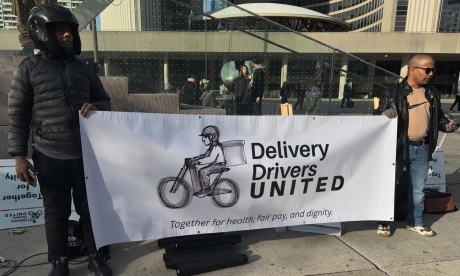
On Monday, November 2, 2026, hundreds of food delivery workers took to the streets of Toronto to protest poverty wages, exhausting working hours, dangerous conditions, and the lack of basic workplace protections.
These are the workers we see every day racing against time, through rain and bitter cold, delivering food to our homes and offices, while many remain uncertain whether they will earn enough to pay their rent or provide for their families.
Some work 12 or 15 hours a day. They wait outside restaurants for orders, pay for their own fuel and vehicle maintenance, and face the constant dangers of the road. If a worker is injured or their bicycle breaks down, they can lose their income in an instant.
Some even complained that restaurants refuse to let them use washrooms while they wait for deliveries.
What a cruel contradiction: the workers who make sure others receive their food may struggle to put food on their own families' tables. Those who make other people's lives more convenient cannot find time to rest.
But the Toronto protest was not simply an outburst of anger. It followed nearly eight months of organizing through Delivery Drivers United, a group bringing together more than 900 delivery workers from different platforms.
The workers gathered at Nathan Phillips Square before marching to Uber's office, demanding living wages, health insurance, transparency in how their earnings are calculated, and an end to arbitrary account deactivations.
Workers who usually spend their days isolated behind smartphone screens had come together to confront the corporation that controls their livelihoods.
And this is precisely what the corporations fear most: workers who experience exploitation individually discovering that they can fight it collectively.
In Montreal, watching the same struggle unfold in Amsterdam
That same evening, hundreds of kilometers from the streets of Toronto, I was sitting in a cinema in Montreal, the city where I live, watching In This Together, a documentary by Dutch filmmaker Lisette Olsthoorn.
Screened by Cinema Politica at Concordia University, the film follows Uber drivers in Amsterdam as they challenge their working conditions and attempt to organize collectively.
It was impossible not to connect the two events.
While delivery workers in Toronto were protesting Uber, I was watching drivers in Amsterdam confront the same corporation, struggling with the same problems: falling wages, insecurity, the fear of losing work, and the inability to control the conditions of their own lives.
The distance between Amsterdam and Toronto seemed to disappear.
Different cities, different languages, different lives but the same corporation, the same system of exploitation, and the same struggle for dignity.
What I was watching was not simply a documentary about drivers in the Netherlands. It was a story about millions of workers whose lives are increasingly controlled by corporations that promise freedom while taking away their security.
The film recreates a real encounter between three Uber drivers and three company employees, which took place amid protests outside Uber's Amsterdam offices.
Through this confrontation, the documentary exposes the unequal power relations hidden behind the seemingly simple act of opening an app and accepting a ride.
Uber tells its drivers they are independent partners, free to choose when they work and how much they earn.
But what kind of independence is this when the corporation determines fares, distributes rides, changes payment rules, and can deactivate the account on which a worker's livelihood depends?
A driver may own the car but does not control the conditions under which it operates.
They may decide when to open the app, but they cannot determine how many rides they will receive or how much those rides will pay.
They are called independent, yet their economic survival depends on decisions made by a company they have little power to challenge.
Capitalism has replaced the traditional boss with an algorithm, but it has preserved the power of capital over labour and expanded its capacity to monitor workers and control their incomes.
What struck me most about the film was not only the injustice faced by the drivers, but their determination to break out of isolation.
The driver who spends long hours alone behind the wheel begins to discover that their problems are not personal failures.
The fall in earnings is not simply bad luck. The constant insecurity is not an individual weakness. The fear of losing access to the app is not an accident.
These are features of a system designed to place economic power in the hands of the corporation while shifting risks onto workers.
The film's encounter between drivers and Uber employees also raises a wider question about solidarity. Can workers overcome the divisions created by corporate hierarchies? Can those who work in different positions within the same company recognize their shared interests?
This is where individual frustration can become collective resistance—and where the beginnings of class consciousness emerge.
That evening, the title In This Together seemed to express something much deeper than a message of personal solidarity. It captured a fundamental class truth: the Uber driver in Amsterdam and the delivery courier in Toronto are not simply suffering similar injustices. They have a common interest in confronting the system that produces those injustices.
Digital capitalism: old exploitation, new technology
Technology corporations present the gig economy as a revolutionary transformation of work.
Gone, they claim, are the old relationships between bosses and employees. Instead, we supposedly have independent entrepreneurs freely offering their services through digital platforms.
But beneath this language of freedom lies an old class relationship.
The corporation owns the app, controls access to customers, organizes the distribution of work, and determines much of the system through which prices and earnings are calculated.
The worker generally owns little beyond their labour power and the tools needed to perform the job.
The algorithm has become a powerful instrument for organizing, supervising, and intensifying labour.
It can measure time, calculate distances, monitor performance, evaluate workers, and influence their behaviour through ratings, financial incentives, and the threat of account deactivation.
But algorithms are not neutral.
Behind every algorithm are decisions about who controls the labour process, who receives the profits, and who bears the risks.
Technology could be used to reduce working hours, improve safety, and free people from exhausting work. Under capitalist ownership, however, it can become a means of extracting more labour while reducing corporate responsibility.
Here lies the central contradiction of the gig economy: the more power corporations gain over workers, the more they attempt to deny that they are employers with responsibilities toward them.
Uber and similar companies have built business models that seek to transfer significant costs onto workers.
Drivers pay for their vehicles, fuel, repairs, insurance, and maintenance. Delivery couriers bear the costs of bicycles, motorcycles, phones, and equipment. In many arrangements, workers also bear the economic cost of waiting for orders.
The corporation benefits from having a vast workforce available whenever demand rises, without necessarily paying for all the time workers spend making themselves available. Even workers' time becomes a source of exploitation.
In Ontario, new legislation protecting digital platform workers came into effect in July 2025. But its minimum-wage protections apply to time spent performing assignments, not all the hours workers spend waiting for their next delivery.
A worker may remain available for many hours without being guaranteed payment for all that time.
The company benefits from a workforce ready to respond at any moment, while the cost of waiting falls on the workers themselves.
This is a modern expression of what Marx described as the reserve army of labour: a pool of available workers whose competition can be used to weaken bargaining power and place downward pressure on wages and working conditions.
Each driver competes for the next ride. Each courier waits for the next order. Each worker fears rejecting a task they desperately need.
Corporate platforms transform workers with shared class interests into isolated individuals competing for survival.
The goal is not to liberate people from exhausting labour. It is to liberate capital from an ever-growing share of its responsibilities toward workers.
From Amsterdam to Brazil and India: workers break their isolation
Capitalism cannot escape its fundamental dependence on labour.
No matter how advanced the technology, Uber cannot operate a single ride without a driver. Delivery platforms cannot deliver a single meal without a courier.
And this dependence gives workers a power that the corporations would prefer them never to discover.
In Brazil, widespread strikes by app-based delivery workers took place in March and April 2025, spreading across dozens of cities.
Workers protested low pay, excessive commissions, and deteriorating working conditions.
In São Paulo, around 2,000 motorcycle couriers marched to the headquarters of iFood, one of the country's largest delivery platforms, demanding higher payments per delivery and better working conditions.
In India, December 2025 saw protests and strikes involving workers at companies including Swiggy, Zomato, and Blinkit.
Workers challenged low wages, the lack of social protection, and the growing pressure to complete deliveries within just a few minutes.
What appears to customers as extraordinary convenience often means dangerous working conditions for those providing the service.
The promise of delivery in ten minutes can become a demand that workers risk their lives to protect corporate profits.
These struggles have achieved uneven results. Some have faced divisions, limited participation, and defeats.
But they reveal something fundamental.
Workers whose power appears scattered across thousands of smartphones can transform the streets into arenas of class struggle when they organize collectively.
Their strength does not come from the number of followers they have online or the ratings they receive from customers.
It comes from their position in the labour process—and from their ability to stop that process together.
The fight for recognition: important victories and their limits
Gig workers have already won important victories through collective struggle and legal challenges.
In Britain, Uber drivers achieved a landmark victory in 2021 when the Supreme Court upheld their legal status as workers in the case before it, entitling them to protections including minimum wages and paid holidays.
In Canada, Foodora delivery courierswon a significant decision in Ontario in 2020 when the Labour Relations Board recognized them as dependent contractors with the right to unionize.
These victories challenged the fiction that digital platforms are merely neutral intermediaries connecting independent businesses with customers.
They demonstrated that the reality of a working relationship matters more than the label a corporation chooses to give it.
But legal recognition alone cannot eliminate exploitation.
Foodora subsequently withdrew from the Canadian market, exposing how vulnerable workers' victories can remain when corporations retain the power to restructure or abandon their operations.
Rights written into law matter enormously. Yet workers also need the organizational strength to defend and enforce them.
This is why the struggle must go beyond the courts.
It requires strong, democratic unions and workplace organizations capable of bringing together workers who may never share a traditional workplace.
Beyond the app: the human cost of precarious work
The consequences of this system are not limited to Amsterdam or Toronto.
In Egypt, delivery workers face similar forms of exploitation, made even more severe by soaring living costs, weak social protections, and an authoritarian regime hostile to independent workers' organizing.
In September 2023, Ahmed Tarek, a delivery worker for Talabat, suffered a serious road accident that left him with severe injuries and required multiple surgeries.
According to an investigation published by Arab Reporters for Investigative Journalism (ARIJ) in January 2026, his medical expenses exceeded 800,000 Egyptian pounds, forcing his family to exhaust its savings while he fought to establish the company's responsibility.
The worker who had delivered food to countless homes found himself without the protection he needed when he could no longer work.
In the same investigation, 80 percent of a sample of 130 delivery workers said they had never signed employment contracts, while 97 percent reported that their companies did not provide social insurance coverage.
These figures describe the workers surveyed, rather than the entire sector, but they reveal severe patterns of insecurity.
The story is painfully familiar.
In Amsterdam, a driver fears losing access to the app.
In Toronto, a courier fears an accident that could end their income.
In Cairo, an injured worker and his family struggle to survive the consequences of that accident.
Different countries, different circumstances, but the same brutal principle: workers carry the risks while corporations seek to protect their profits.
When a delivery rider crashes, it is not only one individual who falls. An entire family may lose its main source of income.
This is not simply an economic question. It is a question of human dignity.
Organization, not pity: turning suffering into collective power
Gig workers need more than sympathy.
They need independent, democratic organizations, committees built wherever workers gather, and networks of solidarity that cross the boundaries between Uber, DoorDash, Talabat, and other platforms.
They need unions capable of reaching workers who do not share a factory floor, do not work fixed shifts, and may not have traditional employment contracts.
They need guaranteed minimum incomes, payment for waiting time, protection against workplace injuries, recognition of their employment rights, an end to arbitrary account deactivations, and the right to organize, strike, and bargain collectively.
But above all, they need the collective power to enforce these demands.
Laws alone cannot protect workers who lack the strength to defend their rights. Isolated protests cannot transform working conditions unless they develop into lasting organizations.
The experience of Uber drivers in Amsterdam shows why organizing matters.
It challenges the isolation on which the platform model depends.
It brings workers together to compare their experiences, identify common problems, and confront the corporation as a collective force.
And it begins to change how workers understand their position in society.
Collective organization is not merely a way to demand better pay. It is a school of class consciousness.
Workers begin to understand that low wages are not personal failures, insecurity is not inevitable, and the corporation behind the app is not a neutral partner.
It is an employer or economic power with interests that often conflict directly with those of the workers whose labour generates its revenue.
This awareness does not emerge automatically from suffering.
A driver facing declining earnings may blame themselves, other drivers, or migrant workers competing for the same rides.
Competition can push workers to accept increasingly poor conditions in the hope of making up for lost income.
But collective struggle can transform that relationship.
Workers who were encouraged to see one another as competitors begin to recognize one another as allies.
Individual frustration becomes shared resistance. Fear begins to give way to solidarity.
And the struggle for better working conditions becomes part of a wider struggle over wealth, power, and control of the labour process.
Migrant workers and the politics of fear
The question of migrant workers is central to this struggle.
Many migrants work in the gig economy because other employment opportunities are limited by discrimination, language barriers, insecure immigration status, or difficulties having their qualifications recognized.
For some, losing access to an app can mean losing their only reliable source of income.
Others may face additional pressure because of temporary work permits or fears surrounding their right to remain in the country.
This insecurity can become another weapon against collective resistance. Workers who fear losing both their livelihood and their immigration status may find it much harder to challenge abusive conditions.
That is why the fight for workers' rights cannot be separated from the struggle against racism, discrimination, and deportations.
An attack on the most vulnerable workers weakens the bargaining power of the working class as a whole.
The same system that attempts to divide workers by employment status also divides them by nationality, citizenship, and immigration status.
Capital benefits from these divisions. Workers can overcome them through solidarity and common struggle.
From Amsterdam to Toronto: who will control the future of work?
What stayed with me after watching In This Together was not simply the injustice faced by Uber drivers in Amsterdam.
It was the possibility of resistance.
The drivers in the film were not powerless victims. They were workers struggling to make their voices heard, confront corporate power, and build solidarity.
And on the same day, hundreds of delivery workers in Toronto were demonstrating that the same resistance was possible here in Canada.
Perhaps the coincidence of these two events says something important about the historical moment we are living through.
Across countries and continents, workers are beginning to confront the same structures of corporate power.
In Amsterdam, drivers challenge the decisions that control their earnings.
In Toronto, couriers organize to demand decent pay and respect.
In Brazil and India, workers stop deliveries and take to the streets.
These are not yet parts of one unified movement. Their organizations, demands, and levels of strength differ. But they point toward a common possibility: a labour movement capable of crossing corporate, industrial, and national borders.
The working class has not disappeared behind smartphone screens. It is being reorganized under new conditions of exploitation, and it is finding new ways to fight back.
These struggles also raise a question far bigger than the price of a ride or the payment for a delivery.
Why should technology capable of reducing human labour be used to intensify exploitation?
Why should the wealth produced by millions remain under the control of a handful of corporations?
Why should workers bear the risks while executives and shareholders control the rewards?
A society capable of organizing millions of rides and deliveries through sophisticated technology is certainly capable of providing workers with decent wages, safe conditions, secure incomes, and time to spend with their families.
What stands in the way is not a lack of technology or resources.
It is a system in which profit comes before human need.
Winning higher wages and stronger labour protections is essential. Every improvement matters. But the deeper struggle concerns who owns and controls the technology, who decides how work is organized, and whose interests production serves.
Ultimately, freeing labour from exploitation means challenging the relations of ownership and power that place the pursuit of profit above human life.
That struggle begins with everyday acts of resistance: a driver refusing an injustice, a group of couriers organizing a meeting, workers deciding to strike, and colleagues standing together against retaliation.
When I left the cinema in Montreal, the struggle of Uber drivers in Amsterdam no longer seemed distant. It was taking place in different forms on the streets of Toronto that very day.
And it will continue wherever workers refuse to accept that their lives are disposable.
The corporations have the apps, the algorithms, and the money. But workers have something more fundamental: the labour without which none of those corporations can function.
From Amsterdam to Toronto, gig workers are rediscovering that power.
And the workers who create the wealth have the power to change the world.
Section:
Topics:


Featured Event

Events
-
November 15, 2026TkarantoOrganized by:International Socialists
Recent Videos


Visit our YouTube Channel for more videos:

Visit our UStream Channel for live videos: