|
Features
You are here
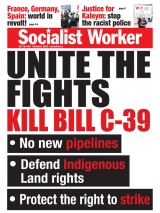
Unite the fights against Carney: Stop bill C-39
October 8, 2026
Mark Carney is moving quickly to secure the future profitability of corporations at the expense of workers, Indigenous groups and the natural environment.
His bill C-39 is an omnibus legislation that will rewrite environmental laws, bypass Indigenous consultation for extraction industries and will limit the right to strike by labour unions.
Carney is calling for privatization of public assets, dramatic increases in fossil fuel production and infrastructure and a new age of mining projects. These schemes will mean a lot of money going to the already rich while the rest of us suffer.
The Liberal government will point to the trade wars and threats of annexation as the reason why we need to move so quickly and recklessly towards these new endeavours but, as we have argued from the beginning of Trump’s term, they are only using Trump as an excuse to pursue more wealth accumulation for the top 1% here.
The Canadian ruling class didn’t need Trump’s threats to push them — they were already eager to crush environmental regulations, suspend workers’ rights and attack Indigenous sovereignty.
In other words, they are doing what they have always done, just with a new momentum and justification.
We have already seen that Carney’s “elbows up” game is something of a farce. A Toronto Star investigation has shown that more than $7 billion in government contracts have gone to US based companies since Carney has come to power.
It is clear that Carney, who spent many years working for US finance giants like Goldman Sachs, has pledged his allegiance to the billionaires, regardless of whether they’re Canadian or American.
The corporate media are, not surprisingly, cheering on Carney and limiting criticism of the new laws. His international popularity is often cited as a point of national pride.
In the past few months he has been lauded around the world. Bloomberg is calling him the “New leader of the free world” after his trip to Europe, following his much publicized CEO summit in Toronto. European politicians lined up to get a photo op with the new messiah of neo-liberalism.
What Carney is actually doing is pumping air into a tired and deflated centre-right political project of pro-corporate globalization that is in rapid decline in almost every part of the world.
Politics in most countries is polarizing with the far-right and the left social democrats gaining support, while the traditional liberal parties disintegrate. They are in that mess because they continue to insist on a project that sees corporate control as the key to fixing the crises of the system.
This is resulting in a cost of living crisis for most working people and has led to the abandonment of these parties by millions of people.
And, although Carney is riding a wave of popularity in Canada his project, which primarily involves mass transfers of wealth to the billionaires, will not keep him atop the polls for long.
CEO summit
The CEO summit brought billionaires from all over the planet together to attract investment in Canada. It was successful if we look at the numbers — more than $500 billion in investment deals inked at the proceeding. But it will be a disaster for working people, Indigenous nations and the natural world.
Among other announcements made at the summit was the privatization of airports which, as we have seen in other parts of the world, will increase costs for travelers, gut union jobs and result in profits going to investors rather than being re-invested in infrastructure.
He also announced a new “Productivity Mega Deduction” for corporations which will result in $36 billion in lost tax revenue over the next 4 years, by one estimate.
Attacking workers
The attacks on workers are not new for the Liberals. Under Trudeau, the federal government frequently undermined collective bargaining and forced workers off the picket lines. From Canada Post to dockworkers in Quebec and BC to Air Canada flight attendants the government used section 107 of the labour code to curtail the constitutionally protected right to collective bargaining.
Carney is now advancing a new model that can force binding arbitration on workers set to strike, which essentially removes the power of the strike as a means to force new agreements. And the decision to do so would not be accountable to any elected body but could be decided by an individual minister in charge.
Unions are planning to defy the new laws. CUPE, Unifor and the Machinists union (IAM) have all declared that they will fight the airport privatization.
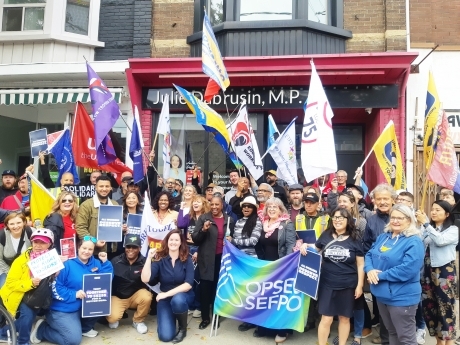
Many of the unions have also stated that they will defy the anti-strike provisions in the law. It remains to be seen what that fight will entail but we have already seen the first actions by unions who picketed federal MP offices in Toronto, Hamilton and Thunder Bay. There will need to be a sustained pressure campaign to get the union leaders to take a firm stance and fight these measures through mass action.
The new legislation also gives the government, again with the full authority of one designated cabinet minister, the ability to fast track projects that are deemed in the “national interest”.
This fast tracking will speed up mining and fossil fuel infrastructure projects that will be both environmentally devastating and will essentially eliminate the possibility of proper environmental assessment and consultation with Indigenous groups.
According to Julia Levin, associate director of national climate at Environmental Defence, ”This will leave Canadians in the dark about risks to communities, wildlife and nature. It also would make it practically impossible for the government to meaningfully consult Indigenous communities on major projects, which is constitutionally required.”
Bill C-39 is an attack on human rights and an assault on the environment on an already burning planet. But these attacks can spark a mass movement bringing together different groups and sectors in one big fight to stop Carney’s corporate takeover.
Unite the fights
On the National Day for Truth and Reconciliation, Carney pledged to implement the TRC calls to action, and labour organizations like the CLC, the OFL and national unions made statements of reconciliation.
These are important as Indigenous people experience apartheid conditions in Canada: high levels of poverty, ill-health, violence at the hands of police, rates of incarceration and everyday violence. But more than just words is needed.
Carney’s hypocrisy is clear: one day earlier he approved the new Pacific Link tar sands pipeline as the first “Project of National Interest”.
He also attacked Indigenous sovereignty with Bill C-39: an omnibus bill expanding on Bill C-5 that establishes “Regions of national interest” to fast track development and dismantle environmental protections.
This fuels forces further to the right mainstreaming residential school denialism, for example in a Globe and Mail editorial earlier this year.
No wonder the Second Sons were emboldened to come to Tk’emlúps te Secwepemc with a banner that said “Got bones?”, denying the horrors of residential schools where 215 unmarked graves had been confirmed in 2021.
The Dominion Society combines remigration – “the return of foreigners to their respective homelands” – with attacks on Indigenous people.
And yet, on September 23rd, 9,000 people joined the Grassy Narrows River Run in Toronto – the largest turnout yet – to demand mercury justice. Significant contingents from labour unions, including USW, CUPE, OPSEU, ETFO, OSSTF, and others were there. It is vitally important to build this. Mercury poisoning health impacts on community members is quite desperate. Recently, a number of community members have died, including a ten-year-old boy who committed suicide,
But there is an elephant in the room.
Notably absent from the march was Unifor, which represents Dryden Mill workers. A key demand of the march was to shut the mill down, directly impacting these jobs. How can we avoid pitting jobs against Indigenous rights and the environment?
Similarly problematic is labour’s response to Bill C-39. This bill further strengthens section 107 of the labour code curtailing the right to strike. The CLC, OFL, major unions and regional labour councils have rightly pushed back against this, but they have narrowly focused on removing this provision, not to repeal the entire bill.
But Indigenous land defenders will fight against Bill C-39 too. Jeronimo Kataquapit from Attawapiskat First Nation and founder of Here We Stand that is organizing resistance against critical mineral mining in the so-called “Ring of Fire”, has expressed concerns that this region will be declared a “region of national interest” under Bill C-39 and urges First Nations to take action: “What we do next isn’t a choice – it’s a responsibility to the future generations.”
These fights need to be unified.
It is imperative that we revitalize climate justice politics, which gained ground with the rise of Idle No More. The Leap Manifesto and the Green New Deal attempted to connect Indigenous sovereignty struggles with a just transition for workers to a green economy, and global justice. This is most clearly expressed today by Quebec Solidaire (QS): they call for a “transition socioécologique”: government investment in green jobs, respect for Indigenous sovereignty and a Quebec for everyone.
Lacking these politics, the labour leadership is moving closer to Carney’s “national interest” and “nation-building” rhetoric, discrediting organized labour amongst Indigenous peoples. This gives a free pass to pipeline building, military production and extractivist projects, driving a wedge between struggles.
This is feeding a growing polarization: jobs versus Indigenous Sovereignty; jobs versus the environment; jobs versus migrants.
A different future is possible if we fight for a just transition and unite the fights!
Section:


Featured Event
Events
-
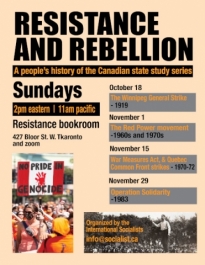
October 18, 2026TkarantoOrganized by:International Socialists
Recent Videos


Visit our YouTube Channel for more videos:

Visit our UStream Channel for live videos: