
|
Reports
You are here
Berlin shows the far-right is not inevitable
September 21, 2026
The radical left has scored a historic victory in the heart of Germany.
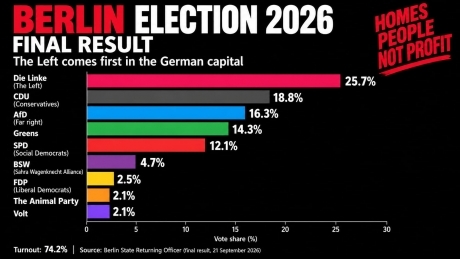
Die Linke won 25.7 percent in Berlin’s state election, more than doubling its 12.2 percent vote in 2023 and achieving its best-ever result in the German capital. It finished clearly ahead of chancellor Friedrich Merz’s conservative CDU, while the SPD suffered its worst-ever result in a Berlin state election.
The result matters far beyond the ballot box.
Berlin is a city being squeezed by soaring rents, property speculation and the cost of living. Die Linke put housing at the centre of its campaign, alongside the cost of living and public transport. It also demanded implementation of the 2021 referendum in which Berliners voted to expropriate the city’s giant corporate landlords.
That points to an important lesson at a moment when the far-right is growing across Germany and gaining electoral successthemselves.
The AfD has fed on anger, insecurity, and declining trust in the political establishment. It tries to turn that anger against migrants, refugees, and other oppressed people. And the mainstream parties have repeatedly helped legitimize this politics by adopting tougher anti-migrant rhetoric and policies of their own.
Berlin shows that anger does not automatically have to move to the right.
When the left directs anger towards landlords, corporations, and those who hold wealth and power—and connects it to concrete struggles over housing, wages, and public services—it can begin to offer a different pole of attraction.
But an electoral victory is not enough.
Die Linke will now face pressure in negotiations with the SPD and Greens. They will push it to retreat from its promises, particularly over housing and the expropriation of the big landlords.
The danger is that electoral success is translated into managing the same system that produced the crisis in the first place.
The real strength behind this result must therefore be built outside parliament too—in workplaces, tenants’ movements, neighbourhoods, trade unions, and anti-racist struggles.
Germany still faces a serious far-right threat. On the same day that Die Linke surged in Berlin, the AfD won 38.2 percent in Mecklenburg-Vorpommern.
That makes the lesson from Berlin even more important.
The rise of the far right is not inevitable.
The answer cannot simply be defending a discredited political center that helped create the conditions in which the far right grows.
The alternative has to come from struggle—from turning anger upwards against landlords, bosses, and the wealthy rather than downwards against migrants, refugees, and the poor.
When class anger finds its real target, the radical left can advance.
Section:
Topics:


Featured Event
Events
-
October 4, 2026TorontoOrganized by:International Socialists
Recent Videos


Visit our YouTube Channel for more videos:

Visit our UStream Channel for live videos: