|
Reports
You are here
Racist policing is a system, not a scandal
August 13, 2026
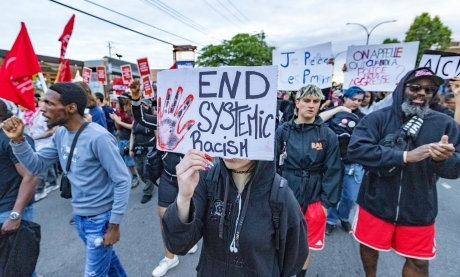
Outside Station 39 in Montréal-Nord, people gathered behind a banner that said what official statements refuse to say clearly: “Racist police, complicit system.”
Svens Telemaque was among them. He was not shocked by the allegations.
“I wasn’t surprised at all,” he said. “It’s been happening for decades. Decades and decades.”
That sentence tells us more about the crisis than all the promises about rebuilding “trust.”
In June, Montreal police dismantled a team at Station 39 after serious allegations of racist and discriminatory conduct. Two officers were suspended, while 14 others were reassigned away from contact with the public. The allegations were serious enough that prosecutors were asked to consider possible criminal charges.
But this is not simply a story about 16 police officers.
It is a story about power.
“Since I was young I saw stuff”
Samir Bensalem grew up in Montréal-Nord. He came to the protest because this was his neighbourhood.
“Since I was young I saw stuff that we wouldn’t see in other neighbourhoods,” he said.
Another protester, who did not give her name, spoke about something familiar to many Black and Arab Montrealers: being stopped again and again.
“We have heard many testimonies from people who are stopped repeatedly because they are perceived as being of Arab, Black or African origin,” she said.
This is what the language of “racial profiling” can sometimes hide: the everyday humiliation of being treated as suspicious in your own neighbourhood.
You walk down the street. You drive home from work. You wait for a friend.
And suddenly you have to explain why you are there.
For racialized people, migrants and refugees, this is not an abstract debate about policing. It is about who is allowed to move through the city without fear and who must constantly prove that they belong.
The problem is bigger than Station 39
The official response has focused heavily on restoring public confidence.
But confidence is not the fundamental problem.
The problem is racism.
Joel DeBellefeuille of the Red Coalition put it plainly. For many Black and racialized people, the allegations at Station 39 were disturbing—but hardly surprising. Communities, he said, have been raising the same issues for years: racial profiling, unequal treatment, street checks and being viewed with suspicion because of who they are and what they look like.
Alain Babineau of the same organization asked another crucial question: where were the supervisors?
“How long has this been going on?” he asked.
Exactly.
If racist practices can continue inside a police unit, the question cannot stop at which individual officer said what or did what. We have to ask who knew, who remained silent, who supervised, and what kind of institution allowed it to happen.
This is why calling the scandal an isolated incident is so dangerous.
It transforms a political problem into a personnel problem.
Remove a few officers. Move others. Announce new training. Promise to listen.
Then wait for the headlines to disappear.
Montréal-Nord remembers
People in Montréal-Nord have reasons not to accept that story.
In 2008, 18-year-old Fredy Villanueva was shot and killed by a Montreal police officer. His death became a symbol of the anger felt by racialized youth who had experienced years of surveillance, police stops, poverty and exclusion.
Eighteen years later, residents are again being asked to believe that the institution will reform itself.
But racism does not exist separately from the social conditions of Montréal-Nord.
The worker coming home late from a warehouse, the refugee waiting for a bus, the Black teenager standing with friends, the undocumented worker afraid that any encounter with authority could have consequences—these people experience the city very differently from those who never have to think twice when a police car slows beside them.
Racism tells workers that their neighbour is the danger.
Capitalism gives that lie a material foundation: unequal neighbourhoods, precarious immigration status, low wages, bad housing and institutions with enormous power over people who possess very little.
The result is division.
Black against white. Immigrant against citizen. Refugee against Canadian-born worker.
And while we are divided, the people who profit from low wages, precarious work and poverty remain safely above the fight.
Racism is a working-class issue
For the Immigrant Workers Centre, police racism cannot be separated from workers’ rights.
A migrant worker can be exploited by an employer in the morning, threatened by their immigration status in the afternoon and racially profiled on the way home at night.
These are not three separate worlds.
They reinforce one another.
A worker who is afraid of authorities is easier to exploit. An undocumented worker who fears any encounter with the state has less power to challenge an abusive boss. A society that constantly portrays migrants, Black people and racialized communities as threats makes it easier to deny them rights while convincing other workers that these are privileges reserved for someone else.
That is why anti-racism cannot be an optional addition to the workers’ movement.
It has to be at its heart.
We don't need another promise
Police “awareness” training will not be enough.
Public-relations campaigns will not be enough.
Moving officers from one station to another will not be enough.
We need an independent and transparent investigation. We need an end to racial profiling and discriminatory street checks. We need real accountability when police abuse their power. Above all, the communities subjected to policing must have a real voice and real power in determining what safety means in their neighbourhoods.
At the Station 39 protest, Hantz Vius described the allegations in four words:
“Disgusting, but not surprising.”
That is precisely the problem.
When racism becomes unsurprising, something far deeper than the behaviour of a handful of officers is wrong.
Real safety will not come from making Black youth afraid to walk down their own streets. It will not come from making migrants afraid of the institutions around them.
It will come from decent housing. Good jobs. Living wages. Full immigration status. Properly funded public services. Strong communities where people look after one another instead of being encouraged to fear one another.
And it will come through solidarity.
The fight against racism is not a struggle that Black people, migrants or refugees should have to wage alone. It belongs to all of us.
Because an injury inflicted on one section of our class is ultimately a weapon against us all.
Section:
Topics:


Featured Event
Events
-
October 4, 2026TorontoOrganized by:International Socialists
Recent Videos


Visit our YouTube Channel for more videos:

Visit our UStream Channel for live videos: