
|
Features
You are here
Hunger for revolution in India amid state terror on protestors
July 22, 2026
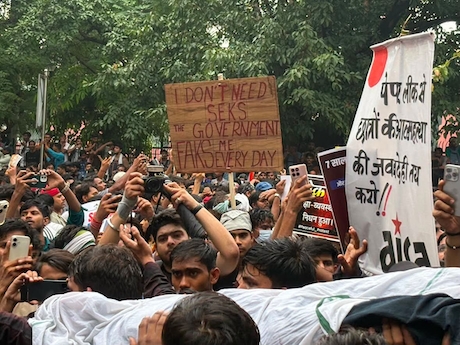
Screams of terror and agony were heard in India’s national capital on Monday July 20 as New Delhi police and the Central Reserve Police Forces (CRPF) descended upon protestors, predominantly students, marching towards parliament to express their discontent with the nation’s education system. Over 50,000 were in attendance.
Hundreds of videos on social media show police physically attacking protestors including children as young as 10, pregnant mothers and senior citizens, groping women and girls, and manhandling and arresting protestors.
Much of the state violence against protestors and even onlookers is being carried out using lathis or long, heavy wooden or bamboo sticks, often reinforced with iron bands. Many were caught on video, at the protests, with nails inserted in them. Photographs and videos show many people, predominantly young students, with blood soaked faces, bruises and other visible injuries. There are also reports of broken bones and fractured skulls. Hospitals and protest organizers have confirmed at least 150 hospitalisations. People are also reportedly using tasers, pellet guns, and expired tear gas.
Discontent
The leader of the opposition party Indian National Congress (INC), Rahul Gandhi, was also manhandled, physically dragged and arrested by police on Tuesday morning before being released some time later far from the protest site.
Children were seen in tears, shaking and visibly traumatized across the scene, seemingly shocked that their state would treat them the same way that it has treated the people of Kashmir (whom India has illegally occupied), Assam, Nagaland, Mizoram, Arunachal Pradesh, Manipur, Sikkim, indigenous/tribal communities, Sikhs, and Dalits for decades.
After 12 years of the Hindu nationalist and fascist Bharatiya Janata Party (BJP) rule including an allegedly rigged general election, record high unemployment and massive state repression, discontent against the establishment is at an all time high in the world's most populated nation. The mishandling of resources after constraints from the Iran war has added to people’s frustration.
The spark for these recent protests, however, was first ignited when National Eligibility Entrance Test (NEET) exams – notoriously difficult and important exams for medical university admission in India – were cancelled after the exam questions were leaked leading to a massive scandal and widespread outrage against an education system broken since colonialism and a long list of exam paper leaks over the years. When activists representing students sought relief from the Supreme Court of India, the Chief Justice Surya Kanth made a comment calling students and unemployed youth "cockroaches" leading to even more outrage and the formation of the Cockroach Janata Party (CJP) or Cockroach People's Party.
Sonam Wangchuk, a prominent environmental activist, also expressed his support for the frustrated students and started a hunger strike in solidarity.
It's important to note that while the CJP initiated the call to action that started these protests a few weeks ago, the protests have grown significantly larger than the CJP and Sonam Wangchuk.
Much of this growth has come from the immense dissatisfaction against the establishment by the masses and has been organized by left-wing groups.
“People don't really care about the leadership (of the protests). I heard a lot of criticism of Dipke (CJP founder) and the CJP leadership at the protests", Rohan (name-changed for his safety), a 24-year-old student attending the protests said in a recent telephone interview.
“Many leftist organisations and marginalised organisations were present. Without them none of this would have been possible, because they were aware of the extent of the brutality the Indian state is capable of. A lot of average urban students there were oblivious to that reality. That illusion is now broken”, Rohan added.
Protests expanding
Since Tuesday, farmers, liberals, and various groups with grievances against the establishment have joined the students in their protests that have now expanded across the country. Indians in the diaspora have also been protesting outside Indian embassies across the world including in Toronto, Washington, and London.
John (name changed for his safety), a 23-year-old recent graduate, spoke to me about his experience attending a protest in West Bengal.
“The protest was organized by the Students Federation of India (SFI), the student wing of the Communist Party of India - Marxist (CPIM) in West Bengal. I was at the Jadavpur branch of the protests where there were tires burned and a road was blocked for 30 minutes. The students of the university overwhelmingly supported the protest. There were other protests held throughout the day at other places and all the labour unions and left wing groups showed up”, he said.
The BJP government has additionally deployed the Central Industrial Security Force (CISF) and Border Security Forces (BSF) in response to the growing protests as police appear to be stretched thin.
The BJP is also scrambling to organize its propaganda apparatus against the protests. Mainstream news media in India, largely controlled by the BJP and its wealthy allies, have been demonizing the protesters and failing to report on state violence against them. As such, young Indians have been using social media to stay informed about these protests and organize themselves.
Reporters from mainstream outlets are being heckled at protest sites as protestors shout “Godi media” at them. “Godi (Hindi: Lap) Media” is a term that has been popularized in recent years to accuse mainstream news outlets of being lapdogs of the BJP.
The BJP’s army of bots and paid influencers are also trying to take back control of the narrative but for the first time seem to be on the losing side of the propaganda war. Some influencers have come forward to blow the whistle on huge sums of money that they're being offered to defend the government and demonize the protests.
Across social media as well as on the ground, there appears to be mass support for the protests and many are calling for revolution with the slogan “Inquilab Zindabad” or “long live the revolution”.
Establishment desperate
People are also fighting back in other ways. There are videos of protestors defusing tear gas canisters or even throwing them back at police, aiding injured protestors, and letting out detained protestors from police buses.
The manhandling and arrest of even mainstream political leaders such as Rahul Gandhi suggests an establishment that is scared and desperate.
Rahul Gandhi, a liberal politician, is the son of former Prime Minister Rajeev Gandhi, grandson of former Prime Minister Indira Gandhi, and great grandson of Jawaharlal Nehru, the first Prime Minister of India. As such, he has even more political power than the few symbolic princes who remain in some parts of India. If somebody with his privilege is also being targeted with violence by the state, one can only imagine the ruthlessness with which this state treats its ordinary people and especially the most vulnerable people under its rule.
Even with all the violence and cruelty that the state has inflicted upon the protesters in Delhi in recent days, it is hardly a fraction of the violence and bloodshed that the Indian state has, for decades, inflicted upon the people of Kashmir (whom India has illegally occupied), Assam, Nagaland, Mizoram (whom India bombed), Arunachal Pradesh, Manipur, Sikhs, Dalits and others for decades.
This Hindu nationalist government, before turning its cruelty towards students, also targeted Muslims, Christians, women, LGBTQ people especially trans people, Dalits, and other marginalized groups.
But as economic conditions have worsened after decades of neoliberalism and 12 years of fascism that promised good days, many across the Indian subcontinent seem to be waking up to the reality that their enemies are not other working class people but in fact the politicians and ultra-wealthy who seek to divide, control and exploit them.
Section:
Topics:


Featured Event
Events
-
October 4, 2026TorontoOrganized by:International Socialists
Recent Videos


Visit our YouTube Channel for more videos:

Visit our UStream Channel for live videos: