|
Arts
You are here
Art is a Weapon - Revolutionary and Antifascist Posters from Spain, 1936-39
July 16, 2026
This is the 90th anniversary of an earth-shattering event of resistance against fascism, known as the Spanish Civil War. However, the years 1936-39 also saw a revolution from below where in the words of George Orwell “the working class was in the saddle.”
The ultimate victory of the fascists was followed by bloodshed, mass graves, and the Franco dictatorship lasted until the late 1970s. But the moment of hope that emerged in 1936 must not be forgotten and holds much inspiration today – the possibility of uniting a society against a fascist threat and the potential for this to lead to even more fundamental social change.
In the heat of the moment, art deployed in the streets has always been used to move hearts and minds. Agitation and propaganda, for the right purpose, can counter all the false capitalist advertising controlled by the corporate media and corporate-owned social media. In the philosophy of the anti-fascist thinker Hanna Arendt “cultural artifacts” such as art, literature, monuments – and posters – can capture and freeze in time the all-too-fleeting experience of revolutionary struggle and make it feel a little bit real again.
That is very much true of this powerful poster exhibit, curated for Ottawa’s Education for Liberation Collective by Claire Nicolson-Hurtig ( @encrenoire.illustration) Posters for Palestine 2024 exhibition, Education for Liberation Collective). It was organized with a view to the present rising of the far right internationally and the silence and collaboration of present-day governments.
As the exhibit description attests, the posters “illuminate a history that extends into the present moment and to struggles we continue to fight today, from opposing fascism, fighting for gender liberation, defending children’s genuine health and well-being, and defending the dignity and well-being of working people to fighting for environmental sustainability, for public education and art, and supporting international solidarity.”
From socialized childcare and libraries for workers, to the presence of women in all aspects of the revolution, including the workers’ militia, the images and slogans in the posters chosen painted a vibrant picture of a society that was being transformed from the bottom up.
Even the posters themselves demonstrated this concretely: they were identified not only by artist but by the name of the newly-collectivized print shop where they were produced and the union the printers belonged to.
Posters, artifacts, screenings
The exhibit presented reproductions of 25 of the thousands of posters produced by the artists, organizers, unions, and leftist political parties of 1930s Spain, reproduced from the collections of the Fundacion Pablo Iglesias (Madrid, Spain), the Robert D. Farber University Archives and Special Collections of Brandeis University (USA), and the Centre de Recursos per Aprenentatge i la Investigació at the University of Barcelona (Spain).
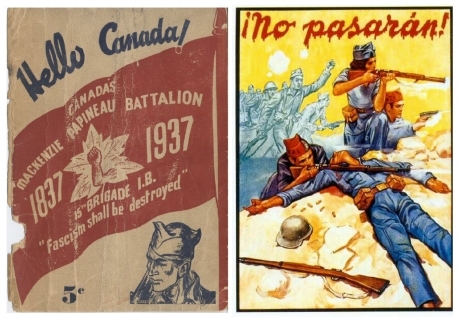
One section of the exhibit focused on reproductions of artifacts from the Mackenzie-Papineau Battalion, the Canadian contingent of the International Brigades that fought in Spain. It included letters from some of the 1500 Canadians who volunteered to fight to defend republican Spain against Franco’s fascist coup, with no official support from the Canadian government.
I was fortunate to get a tour of the exhibit by curator Claire Hurtig, who previously curated an exhibit about the genocide in Gaza in the same space. Part of the exhibit highlighting posters calling for international solidarity with republican Spain also included a call for support for Gaza, creating a meaningful echo with the present.
But Claire also pointed to other parallels: the inaction, complicity, and sometimes active support of mainstream governments for genocide and other policies that are fueling the growth of the far right. She read key passages from George Orwell’s Homage to Catalonia that pointed to the contradictions of a movement simultaneously resisting a fascist coup and trying to defend the new society of collectivized industry and land, run democratically by workers and peasant themselves – all the while dealing with forces that claimed to be keeping the fascists at bay but which ultimately betrayed the movement on the ground.
The program surrounding the exhibit also included screenings of important films about the Spanish Civil War and other working class struggles of the 1930s (Land and Freedom, Cradle Will Rock) as well as a workshop on political poster-making and collage. The exhibit ended on June 20 with a sale of beautiful poster reproductions, and a promise of more to come from Education for Liberation Collective in Ottawa.
In the words of the Revolution to the fascists: No pasaran! (They shall not pass).
Section:
Topics:


Featured Event
Events
-
October 28, 2026VancouverOrganized by:snəw̓eyəɬ leləm̓ Langara International Socialists
-
November 1, 2026TkarantoOrganized by:International Socialists
-
November 1, 2026TorontoOrganized by:International Socialists
Recent Videos


Visit our YouTube Channel for more videos:

Visit our UStream Channel for live videos: