
|
Reports
You are here
Postal workers vote on tentative agreement - What is at stake?
May 7, 2026
After over two years of negotiations, postal workers are voting on a tentative agreement recommended by 60% of the National Executive Board.
In the process, Canada Post stalled negotiations and even walked away from the table on several occasions. It ignored CUPW union delegates and the proposals voted on by 93% of CUPW members.
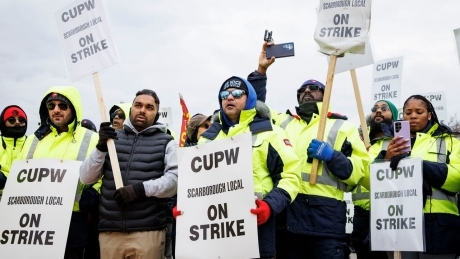
This fightback has been a difficult one. Postal workers have had to stand their ground in the face of Canada Post’s demands for major rollbacks and concessions. They have waged two all-out strikes, rotating strikes, a ban on overtime and flyer distribution. Union members rallied across the country outside offices of federal MPs and at the Ottawa headquarters of Canada Post. They blocked Purolator trucks moving parcel mail that Canada Post shifted to competitors. They withstood a government-imposed vote on the employer’s choice demands, resoundingly rejecting it.
CUPW members also launched a nation-wide campaign to save the public postal service from cuts to services currently underway by Canada Post and the Liberal government – closing post offices, replacing door-to-door delivery with community mailboxes and in the process eliminating thousands of jobs.
Canada Post and the Liberal government have attacked postal workers’ jobs, their right to strike and collective bargaining. They have announced major cuts to postal services without public consultation as expected under federal legislation.
Canada Post has blamed postal workers for its declining financial status throughout this round of negotiations. Doug Ettinger was hired as CEO of Canada Post in 2018. Ever since, it has experienced consistent and ever increasing losses. Yet postal workers have watched in dismay as each year the CEO and other board members have awarded themselves huge bonuses.
Why does this keep happening? The answer is that Ettinger is doing what he was hired to do – erode services, cut jobs, incur financial losses, and lay the groundwork to privatize the postal service.
And now, after this long struggle, postal workers are voting on a tentative agreement in locals across Canada. Voting is expected to finish at the end of May.
This tentative agreement has caused intense debate among members. This division is reflected in the less than unanimous recommendation from the National Executive. Nine voted in favor of recommending the tentative agreement to union members, but five were opposed, including national president Jan Simpson.
A number of CUPW locals are also recommending a “no” vote including locals in Halifax, Toronto, Saskatoon, Edmonton and Vancouver. Some union members have set up a cupwvoteno.cawebsite, arguing the tentative agreement contains many rollbacks rejected by the members in the July 2025 forced vote.
A minority report from the five dissenting National Executive members argues the agreement abandons the 2023 demands unanimously endorsed by the National Executive and 93% of CUPW members. The agreement, they argue, is a huge victory for the employer.
The National Executive members recommending a “yes” vote, have presented the usual fatigued argument, ’this deal was the best they could get,’ before presenting gains -- keeping the defined benefits pension plan and securing wage increases.
It is hard to tell where the vote will land at this point. A strike vote is being conducted at the same time as the vote on the collective agreement. The National Executive as a whole is recommending a “yes” vote for strike action. Either way, a “yes” strike vote will show postal workers can be a united force. If it is paired with a “no” vote on the agreement, strike actions of various sorts will be back on the table. So too will be the prospect of a lock-out and back-to-work legislation.
Whichever way CUPW members vote, we cannot be expected to carry the battle with Canada Post and the Liberal government alone. While unions, socialists and activists on the ground, notably in Edmonton, Toronto and Halifax, have built strong solidarity in this battle, a glaring need has been exposed. We must build a strong unifying fightback against an ongoing and large anti-union offensive by employers and provincial and national governments.
In this effort, the Canadian Labour Congress needs to step up significantly. It has so far failed us in the role it was intended to play in the labour movement. We need strong cross-labour forums to build a movement with broad public support and a united strategy. We must meet this government offensive with a labour offensive for decent jobs, decent working conditions and protected public services.
Section:
Topics:


Featured Event

Events
-
October 4, 2026TorontoOrganized by:International Socialists
Recent Videos


Visit our YouTube Channel for more videos:

Visit our UStream Channel for live videos: