|
Features
You are here
Socialists and the trade unions
January 9, 2026
Anyone looking at the labour movement today can see the real potential for a broader struggle and the need for a more robust resistance to the attacks that working class people are facing. And yet we see very little lead coming from the top of the labour leadership. Leaders may hold press conferences and do some saber rattling, but it is not spilling over into building a broad sustained resistance.
Back at the beginning of COVID, there was a real retreat in the class struggle. Workers faced a new moment as people were being sent home and there was general disarray.
In 2022 there was a change and workers started pushing back. People realized that we were not all in this together and it fuelled anger and frustration. This was coupled with the growing inflation that workers see when they go to grocery store, see their rents getting jacked up, the sorts of things that bankers, businessmen and bosses don’t feel.
Although there was no generalized lead from any union leader around the question of inflation, across the country there were pockets of strikes and some historic victories in terms of record-setting contracts between 2021 and into 2024.
There were brilliant strikes: Poultry workers in Quebec picked a perfect moment in 2021 to go on strike and almost froze poultry production in the province of Quebec. A thousand food workers in Guelph shut down all beef production in Ontario in 2024.
Members were rejecting tentative agreements by large margins, sometimes 99%, saying this is not good enough, even when bargaining teams were getting some small gains. It was a particular moment, a moment when there was a labor shortage that for the first time in people’s living memory, whether they could enunciate it or not, there was a knowledge that they need us much more than we need them. Workers in some sectors got the largest raises they’ve ever seen. But, from the top of the labour leadership there was nothing. Not even a recognition that the issue of inflation is a serious thing. It was kind of treated as, oh, yeah, sure, it’s not good, but it’s not that bad.
The ruling class did attempt to address inflation. They did it with three mechanisms. The first was to try to erode the confidence of labor by creating a larger surplus army of labor, which is the unemployed, to erode that confidence that the bosses need us more than we need them. The second was to create economic problems for workers beyond inflation. They put people in a double-edged bind where inflation was met with interest rate hikes. People who had to renew their mortgages, who had car payments and credit card debts saw rates that were soaring.
The third thing was to say the issue was low productivity, which is completely counter-intuitive because if you drive up interest rates, in a capitalist view of the world, that means businesses don’t borrow money to build productivity. Increasing productivity under capitalism really means a higher rate of exploitation to squeeze more out of workers. They want us to work more for less pay. Again, this is the mantra of the Canadian ruling class.
Together these actions have made working people afraid and feel the need to hold on to what they have. At the same time there is no incentive for businesses to borrow money to expand. But for the banks, it means huge profits.
Where is the labour leadership?
In Canada, the UK, and most of the English-speaking world, there has been very little centralized labour resistance to this. If you look back to the 1970s, there were at least calls for one-day strikes, a national one-day strike, and national one-day mobilizations around the issue of inflation. There is no call to boost up picket lines, to build strikes, to knit these things together into a mass working class movement in the face of the cost of living crisis.
Carney is unleashing massive attacks on workers. At the same time, millions and billions are being handed out to corporations under the guise of nation building projects, while thousands of workers being laid off in steel and auto plants. Why on earth is there no call for action from our labour leadership?
They haven’t even taken a nationalist position of saying, all right, we’re elbows up; we’re all in this together. Let’s nationalize the steel industry. Let’s take over the CAMI electric vehicle plant. Instead, we see nothing from the union leadership.
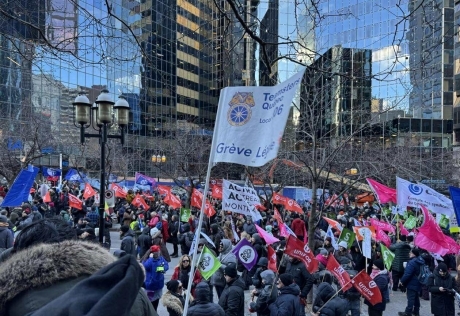
At Canada Post the Liberals smash and strip away the right to strike and we get nothing from the CLC. It was the Air Canada flight attendants themselves who moved. It just brings us always back to the question, why is it that what would appear to be in the material interest of the democratically elected union leadership, and when workers are willing to fight, that there is nothing from the top? It baffles the mind that there is a moment that we could really tip this agenda backwards away from the Liberals and the bosses and yet nothing comes about.
So why is this? There are different explanations. Some people expect unions to be radical entities because on the surface, the notion that workers would have a right to force an employer to bargain with them kind of undermines the whole edifice of capitalism. Profit and ownership are the keys. So, the existence of unions in their own right undermines some of the ideological underpinnings of capitalism. But unions have also become very incorporated into the laws and regulations of the system.
There is also the explanation that the leadership of the unions is just bad, which on the surface is a fairly accurate assessment. But it isn’t necessarily because they are bad people. We have to look at a couple of things about the nature of unions.
If they are bad leaders it is because they can’t see outside of the framework they operate in. Why is that?
If you go back to Rosa Luxemburg, she talks about union leaders and unions becoming institutions on their own, where the object of the institution, which is to raise workers up and pose a political challenge to unfettered capitalism, gets lost. The union itself becomes the object. For example you may have heard, we can’t go on strike, it would bankrupt the union. Or, if we break the laws, they’re going to fine the union, they’re going to fine the union leaders. Of course, it is serious if you are the president of a small local and could lose your house if you get fined. But if the rest of the labour movement stood up and said, don’t worry, we’re going to buy your house from the bank and give it back to you, it would be a different situation.
If there was that sort of solidarity, we could cut through these threats. But the notion becomes that the union itself has to be preserved, even if that means it no longer does what it’s supposed to do, which is to lift up workers and move them forward.
Unions have become big entities trapped inside labour laws, and a logic develops inside of them where the union, the institution, starts to trump the objectives of the institution. If the union is going to get fined out of existence, well, we can’t have this wildcat strike, right?
The divide between the rank-and file and the leadership
So with the bureaucratization and the shift to identifying the union as the object, the divide inside the labor movement isn’t between left-wing union leader and right-wing union leader, as most of the left thinks of it. It is not an unimportant distinction. It does matter which leader is going to create more space for the rank-and -file to organize and fight back. But, the main divide in the trade unions, the organized section of the working class, is between the rank and file and the leadership.
Some people interpret this as socialists saying that if we didn’t have this leadership, there would be mass strike waves. We’re not spontaneists. We don’t believe that struggle just materializes. We think capitalism produces struggle, so people will always fight back. We believe there needs to be leadership and there’s a need for a revolutionary organization.
But inside the union movement, if we look at the last moments we’ve been through, if we look at the Air Canada strike, if we look at some of the petty factionalism that goes on between unions, millions spent on lawyers, you can see where their priorities are. We see the main divide is between on one hand, a bureaucracy that puts the institution ahead of the members and on the other hand the rank-and-file members. What we want to fight for is the members. We always want to fight for more rank-and-file control, even when workers vote for things we don’t like.
We want, as much as possible, to have open debates about strategy, tactics, what needs to be done. We don’t want closed conferences, we want big conferences for workers to be at, like CLC and OFL conventions.
When workers have a say, and there’s a debate: Why aren’t we organizing? Why didn’t we rally around the Air Canada workers? They don’t do what the leadership always wants them to do. The leadership is constantly trying to suffocate those sorts of things.
What we mean by a rank-and-file strategy
That’s why when we say we have a rank-and-file strategy, it’s not because we fetishize the rank-and-file, but because we know inside the labor movement there is this gap.
There is a division between workers and their leadership. The unelected bureaucracy, and the elected leadership, particularly at the national and provincial levels have an interest in the maintenance of this system. Thhey don’t have an interest in overthrowing capitalism. They don’t have an interest in destabilizing the situation we’re in. And we see that if you look through labor history, look at the Operation Solidarity strike in BC in the 1980’s, the Days of Action in Ontario in the 1990’s. Not only in Canada but around the world, the same thing happens. Huge movements rise up and the leadership runs to the front to try to bring it down and put it back into “normal” channels.
Which is why it becomes all the more important for rank and file people to push, to say, this is what a mass struggle looks like. It means when there’s a picket line, those workers don’t sit there and we don’t play this bureaucratic game of waiting for that union to say, please come join our picket line. We organize and we mobilize. And that’s what builds muscles inside the working class, is when people organize and fight.
When we have a cost of living crisis that involves direct confrontation with employers, it means stepping up and fighting the Carney government. So that’s why for revolutionary socialists, it’s not just about criticizing, it’s about getting in and trying to build rank-and-file networks, trying to say that this is our best way to push the labor movement forward.
Imagine if at Air Canada, there had been a network of rank-and file activists: some in Toronto, some in Vancouver, some in Winnipeg so that when the online votes were happening, there was a coordinated no. Not just voting no to the contract, but going back on the picket line. I don’t want to minimize how hard this work is but imagine if that existed and they had been able to network. It wouldn’t have taken much in terms of lateral, across-the-board, rank-and-file organization to flip that situation and keep the pressure on Air Canada.
Everybody should be so frustrated right now that we are letting another moment pass. Although people have illusions in this elbows up thing, we had a moment and we still have it to drive a truck through that, to say if we’re all in it together, the banks are going to loan working class people at 0.0001% money to buy homes. We are going to loan cooperatives hundreds of millions of dollars to build cooperative housing. We are going to nationalize the steel industry.
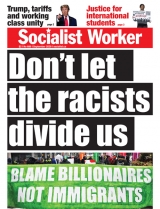
We can see the possibility to really drive a radical agenda and turn the anger away from immigrants, away from people on student visas, onto who it really deserve it: Poilievre, Carney, the Westons, the Sobeys. There is a palpable anger everywhere at the 1%, at the rich. The people that should be driving that agenda, the trade union leaders, and the NDP, have abandoned that terrain, which is why we see Poilievre and the far right soaking it up.
Our analysis is that we need rank and file organization. We need to always be looking at the base and we need to always strategize about how do we build. Struggles have to be viewed through a lens not of how does this build the left bureaucrat’s profile, but how does this build the space and the confidence of ordinary rank-and-file working-class people to organize and resist? It also means when a strike doesn’t win all the economic demands, we don’t want to sit around and say, this is garbage. We want to say,
we don’t think this was good enough. But if you ask the workers quite often, they’ll say, God, we were facing enormous things. We won, we pushed back and we feel confident. We start with the workers’ confidence. Do people feel more confident? Are they more willing to fight now than they were last week? If the answer is yes, then to me, that’s a victory. And that’s why when we analyze the Air Canada strike, I think it’s a victory. But I also think it’s a glaring example of how much more could have been won, not just for Air Canada workers, but for the whole airline sector, which is on fire. It could have spread and given confidence to other workers to fight back, which could have changed everything.
Section:


Featured Event
Events
-
October 4, 2026TorontoOrganized by:International Socialists
Recent Videos


Visit our YouTube Channel for more videos:

Visit our UStream Channel for live videos: