|
Reports
You are here
Report from Egyptian Parliamentary elections: No Hope for Reform Under Sisi's Rule
December 1, 2025
Translated from the Revolutionary Socialists Egypt
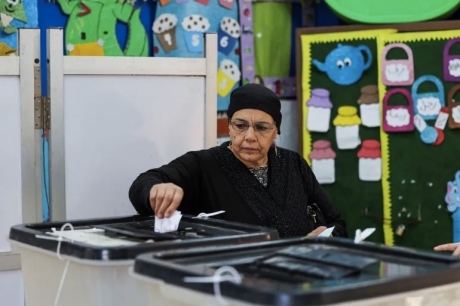
In a new and deeply troubling scene and only months after the Senate election farce, which saw an unprecedented public boycott and the handpicking of security-approved members, followed by Sisi appointing loyalists across every sector—the first stage of the parliamentary elections played out in much the same way. Dozens of candidates from parties and groups outside the circle of absolute loyalty to Sisi were pushed aside, while pro-regime parties tightened their grip and took full control.
The regime did not allow any varying voices the narrowest margin to compete in a short two week electoral battle over half of the parliamentary seats. Meanwhile the other half is made up of candidates on closed electoral lists fully monopolized by pro-regime parties.
These elections, which are supposed to, even constitutionally, embody the popular will, turned into a hidden battleground over individual seats in most districts, with different security bodies clashing behind the scenes. They treat parliamentary seats as spoils distributed among regime loyalists and their networks of interests, while the Egyptian people remain mere spectators to a political play that neither reflects their will nor represents their aspirations.
This rivalry manifested in the public exchange of accusations through media outlets affiliated with each apparatus, and in the use of illegal methods to influence the results.
In many districts, voters witnessed blatant vote-buying, brazen fraud, restrictions on competing candidates, and even armed violence in some cases, especially in Upper Egypt.
The elections saw an almost total absence of any opposition, as the Support Egypt Alliance, Nation’s Future Party, Republican People’s Party, Protectors of the Homeland Party, and the National Front each tied to different security agencies competed over individual seats. Te battle exposed the deep divisions in interests and networks within the state institutions.
These divisions exist within influence, loyalty, and patronage networks, but they do not reflect any division in their absolute support for Sisi. All these entities will ultimately unite in parliament when their real role arrives: amending the constitution to extend presidential terms and secure Sisi and his regime’s continuation beyond 2030.
After the first stage ended with scandals witnessed by everyone and extensively documented most notably the public disputes between judicial bodies, including the Judges Club, the Administrative Prosecution’s Marine Club, and statements from the National Elections Authority, Sisi issued a post on “X” calling for “electoral integrity,” “respect for the popular will,” and “fear of God.” Immediately afterward, the supposedly independent elections committee announced re-runs in 19 districts.
This post, which came at a highly sensitive moment, was a clear attempt to polish the regime’s deteriorating domestic and international image, obscure the chaos caused by the infighting among its own agencies over the available spoils, and present Sisi as a leader above these rival networks, a reformist leader standing for truth and the people's interest.
But the truth known to most Egyptians is that Sisi casts himself as a “referee” while in reality he is the ringmaster of the entire circus. The post revealed the extent of his control over even the smallest details of the political scene, and how he uses social media to polish his image as the “protector of democracy” while running an authoritarian system that leaves no room for genuine, not even marginal, competition.
The unspoken secret, which surfaces in every private conversation behind closed doors, is that this parliament has been assigned one historic mission: to amend the constitution and extend Sisi’s rule. This explains the frantic struggle among candidates and the agencies backing them, as the moment is ripe to gain wider zones of influence and benefit in the period ahead and in the post-2030 arrangements.
Real opposition remained absent both by force and by choice, trapped in a narrow corner between the hammer of systematic state repression and the anvil of co-optation and absorption.
It is an illusion to believe that this parliament will be any different. Under Sisi, the parliament is not the legislative institution that even superficially monitored, debated, or held the government accountable, as it did during Mubarak’s era. It has shamelessly become nothing more than a “rubber stamp,” limited to echoing what is dictated to it and approving whatever is placed before it.
Real decisions from international agreements to multibillion-dollar loans, pass above the heads of MPs, while their debates are confined to trivial entertainment issues or a scramble for personal and individual gains.
Parliament has become a tool for giving superficial legitimacy to imposed policies, and a scene in the larger display of democratic décor that deceives no one.
The 2025 parliamentary elections remain yet another episode in a long series of political orchestrations by Sisi and his institutions. A scene in which regime loyalists fight over crumbs under one roof, while the Egyptian people are left outside the gates, suffering unprecedented living deterioration and a crushing economic crisis, watching with bitterness a spectacle designed to bestow legitimacy on a regime that has lost the ability to convince anyone of its legitimacy.
The message emerging from between the lines of these elections is clear and loud: there is no hope for a genuine democratic transition under a rule that knows only the language of repression and domination. Democracy is not created by a tweet, nor founded by a parliament stripped of will, nor built through the suppression of freedoms.
The only path out of this dark tunnel begins with collective struggle to pressure the regime to release thousands of political detainees, lift the security grip on public freedoms, and open the door to genuine competition that ensures peaceful transfer of power.
Section:


Featured Event
Events
-
October 4, 2026TorontoOrganized by:International Socialists
Recent Videos


Visit our YouTube Channel for more videos:

Visit our UStream Channel for live videos: