
|
Features
You are here
Quebec labour gears up to challenge the CAQ’s attacks: How do we defend the right to strike?
November 3, 2025
In February this year, the Quebec Minister of Labour introduced Law 89, passed in May: “An Act to give greater consideration to the needs of the population in the event of a strike or a lock-out.”
It greatly expands workplaces that can be ordered back to work in the event of a strike, defined as “essential services.” Previously “essential services” were connected to endangering public health or safety. Under Bill 89 that becomes defined as “services ensuring the well-being of the population.” And the Bill gives the government the power to designate, by order, which workplaces are now “essential.”
And it gives the “neutral” Quebec labour board the right to determine whether an employer is providing services that justify both a back-to-work order to end a strike, and the right to impose binding arbitration, eliminating not only the right to strike but the right to vote on your own contract.
Unions have called Bill 89 a return to the anti-union tactics of former Quebec premier Maurice Duplessis, a political and religious conservative who was in power from 1944 to 1959, and who brought McCarthyism to Quebec even before McCarthy. Some have also called it revenge on the public sector for their massive Quebec Common Front strike of 2023.
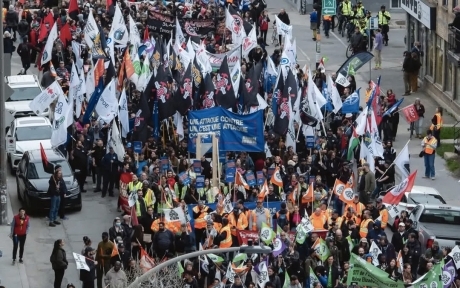
All unions in Quebec called for its withdrawal immediately. There was a months-long campaign against the bill, with large rallies. In the meantime, a Charter Challenge was launched against it as unconstitutional in denying the right to strike.
The law is undeniably unconstitutional in respecting both the Quebec Charter of Rights and Freedoms and the Canadian Charter. And maybe the legal challenge can be used to help fuel a fightback outside the courts. And maybe it can get a legal injunction to suspend it in the meantime.
But the real test will be the willingness to defy its implementation. And it has yet to be tested against an actual strike.
Reigning in the unions
Bill 89 is part of a concerted attack on unions by a CAQ government tanking in the polls. At the same time, the CAQ is rapidly intensifying its appeal to overt racism in the name of “secularism,” fueling a right-wing view of Quebecois identity that targets the Muslim hijab (headscarf) as the enemy. There are also ongoing major attacks on healthcare in the mix. The CAQ’s Bill 2 links a portion of doctors’ compensation to performance targets relating to their number of patients, particularly vulnerable ones.
The open war on unions is a new tactic by the CAQ, and they are going at it from all angles. Bill 3, not yet passed, targets union dues. It aims to make some union dues “optional” if they are directed to “non-union activities.”
CAQ Premier François Legault mandated his Labour Minister Jean Boulet to “have the courage to modernize the union system.” They claim to have the support of union members to “clean up the internal management of unions.” Says Labour Minister Boulet: “We’re not doing this against the unions, we’re doing this for the union members… You can go to Dubai, protest a law, spend exorbitant amounts of money, but only if unions approve it.” He was referring to the participation of FTQ president Magali Picard in the United Nations climate change conference in Dubai in 2023.
But even more revealing is Boulet’s concern over the legal challenge to the CAQ’s racist “secularism” law that prohibits teachers from wearing the hijab. This challenge is supported by a teachers’ union, the Fédération autonome de l’enseignement (FAE). Boulet says he’s not trying to stop challenges to his government’s law, just the fact that the union challenge was brought “without the approval of its members.”
The attack on unions in Quebec may have its own story with a Trumpist government in decline, but it’s in step with persistent attempts to undermine legal rights of unions across the Canadian state.
We can’t trust the courts
There have been increasing attempts to defy or at least contest back-to-work laws. The whole of Alberta has been embroiled in a debate over calling a general strike to support Alberta teachers, who struck in October without even a strike fund. They struck not only over their working conditions but increased funding for Alberta’s starved K to 12 education system.
The Trumpist Alberta UCP government of Danielle Smith invoked the now infamous notwithstanding clause to legislate the teachers back to work. They needed to do this because the Canadian Charter of Rights and Freedoms legally guarantees the right to free collective bargaining, including the right to strike.
The notwithstanding clause limits all challenges to the constitutionality of an illegal law that a province passes – a safeguard which was originally included in the Canadian Constitution to provide the nation of Quebec with a certain amount of national autonomy within a constitution it never signed on to. It was not intended to give anti-labour politicians in the rest of Canada the right to do whatever they want.
And yet, Doug Ford in Ontario used it in the same way. In 2022, Ontario Bill 28, the “Keeping Students in Class” Act, threatened to force low-paid striking CUPE educational assistants, early childhood educators and custodians back to work under an imposed four-year agreement with a strike ban and fines of up to $4,000 per day for individuals and $500,000 per day for the union.
Nevertheless, those vulnerable education workers defied the back-to-work order on their own, even before the rest of the labour movement pledged to defend them. Their own defiance forced the question for the Ontario Federation of Labour.
What forced the Tories to repeal Bill 28 in November 2022 was not a legal challenge but the threat of a general strike across Ontario to back the defiance of education workers themselves, including the threat by Quebec unions to bus in hundreds of supporters to Ontario.
The Alberta Teachers’ Association decided to comply with the UCP’s back to work order. It still sparked a debate over what line must be crossed to force the labour movement to respond to the existential threat to the right to strike. But it was meek from the Alberta Federation of Labour leadership: “A general strike if necessary, but not necessarily a general strike.” In contrast, it sparked a necessary student walk-out, in support of their teachers but also in support of class caps for their learning.
Another piece of back-to-work legislation against Ontario college workers in 2017 was found to be constitutionally legal in 2024. The rationale was that the parties were at a stand-still and there would be no progress if the workers were not ordered back to work and to arbitration.
And now, Section 107 of the Canada Labour Code is in the news. It was shamefully used to force postal workers back to work in December 2024, and when the postal union challenged it in the courts, in October 2025 it was shamefully upheld as constitutionally legal.
Section 107 was used by the Liberals eight times since June 2024 to end (or try to end) strikes: at WestJet, CP Rail, CN Rail, the Port of Montreal, the Port of Vancouver, Canada Post (twice), and of course against Air Canada's flight attendants, who defied it.
A “Liberal love story”
Labour commentator David Doorey calls section 107 a “Liberal love story” that started with the Harper Tories. In fact, it really all started with those militant Air Canada flight attendants back in 2011.
Doorey recounts: “In early October 2011, Conservative Minister of Labour (MOL) Lisa Raitt was seriously fed up with Air Canada flight attendants. Twice a proposed collective agreement had been put before them and twice they had voted it down in ratification votes. She questioned whether something was wrong with the Canada Labour Code such that this could happen.”
Later, one of the Harper Tory reforms was using Section 107 of the Canada Code to use the Canadian Industrial Relations Board (CIRB) to end a subsequent work stoppage by imposing arbitration. But the Tories weren’t the ones to completely override constitutional rights: they just opened the door to the Liberals to go to town with Section 107.
The Liberals tried to legislate the Westjet mechanics strike back to work under 107 in 2024, but failed mainly because of the militancy of those workers.The Liberals kept trying to make the law itself more air-tight, by directing the CIRB to order the parties to “resume operations” and “impose interest arbitration.” So that under the law they would no longer even have to put a question to the “independent” CIRB Labour Board before imposing arbitration, as the Tories had to do in the 2011 Air Canada case. So, the Liberal Minister of Labour could just order the end to a work stoppage.
While many regressive labour laws may have started under Tory governments, Liberal governments have made them work for the same anti-union agenda. And the same is likely to happen in Quebec. If and when the CAQ loses to the Parti Quebecois (itself a historic split from the Quebec Liberals) it will be more of the same.
It is all a great “love story” between employers and the governments and courts who have their interests at heart.
From the courts to the streets?
The Charter of Rights and Freedoms has been ruled to constitutionally protect the right to strike in the courts. The federal government continues to try to weaken it with legislation, and provincial governments continue to pass laws to either get around the Charter or just violate it completely, knowing it will take years to challenge their illegal laws. Meanwhile the damage is done. And even if you do get your day in court, like the postal workers of CUPW with Section 107, the court system can’t even be trusted to uphold the constitution.
Court challenges and illegal defiance of the law are not always counterposed, but legal challenges can sometimes distract or overwhelm the route of defiance on the ground. Or cause demoralisation, since the legal route is stacked in favour of employers.
The Quebec labour movement does have a next move outside the courts. On November 29, there will be a broad inter-union day of protest to say no to Law 89 and to the entire attack on the labour movement – and to budget cuts, and also to the extreme right-wing racist turn of the CAQ government.
The biggest protest will be in Montreal, at 1:30 at the Place du Canada. But there will be actions in regions across Quebec to stand together on November 29.
There must be an attempt to link the massive opposition to the anti-union climate to the explicit racist manoeuvres of the CAQ. There are some forces in the Quebec labour movement that want to show this as the true face of a turn to the far right: attacking unions and scapegoating the oppressed at the same time.
This two-headed monster, against unions and the oppressed, is coming to every part of Turtle Island.
November will be a month to watch in Alberta, as the debate unfolds on the ground over the possibility of a general strike against the latest declaration of war on unions within the Canadian state. But it will also be a month to watch in Quebec.
To defend the right to strike, from Alberta to Quebec: out of the courts and into the streets. Dans la rue!
Section:
Topics:


Featured Event

Events
-
October 4, 2026TorontoOrganized by:International Socialists
Recent Videos


Visit our YouTube Channel for more videos:

Visit our UStream Channel for live videos: