
|
Reports
You are here
Why bike lanes should matter to you
August 11, 2025
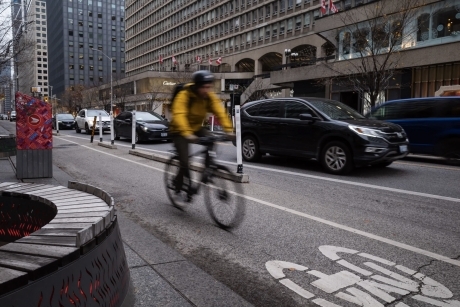
Bike lanes are an indispensable part of any city. They are an affordable form of transportation. They reduce deaths for all road users and improve traffic flow for all forms of transit. Recently an Ontario judge found Doug Ford’s plan to rip up bike lanes unconstitutional. This has been a long process in line with the Conservative government’s relentless attempts to make unlimited profits for their rich buddies and destroy the lives of the working-class people in Ontario. Bill 212 goes against all evidence on building functioning cities. This issue is not just about bicycles; the victory of saving the most vital bike lanes in Toronto is good news for all Ontarians.
In October 2024 Bill 212 the “Reducing Gridlock, Saving You Time Act” was introduced by the Ford government. This bill requires all municipalities to request permission from the Ontario government before building bicycle lanes that reduce the number of motor vehicle lanes on a road. It also requires the removal of the bike lanes in Toronto on Bloor Street, University Avenue, and Yonge Street. Dangerously, it also pre-emptively bars all claims against the government arising from collisions, injuries or deaths that will result from the removal of the bike lanes.
The bill’s name “Reducing Gridlock, Saving You Time Act” would imply that there is significant evidence that bike lanes cause traffic congestion. This is something that was brought up during the case. The government’s expert witness Dr. Haider touched on certain issues with traffic congestion in Toronto, but surprisingly he did not address whether removal of the target bike lanes would relieve congestion. The government also had a retired fire captain from the Toronto Fire Services speak. He asserted that the bike lanes on Bloor Street West will have “a detrimental impact on emergency response times.” This goes directly against the public statements from the Toronto Fire Chief which said, in October 2024, that the fire department had “not seen an increase in response times” and “response times have been improving.” The lack of evidence put forth by the government that bike lanes cause congestion is staggering. Worst of all, Dr. Haider argued that bike lanes cause congestion, which results in emissions which harms cyclists exposed to them, an argument of illogic. After hearing the government’s experts’ opinions, the judge concluded “[t]he government’s evidence is anecdotal and of little assistance. The affiants are not experts and have not analyzed the causes of congestion.”
Since the government’s evidence is of little assistance, what are the ways to actually solve traffic congestion? An important, well-accepted concept that was brought up during the case is induced demand. Induced demand is the observation that after transportation infrastructure is built, people will use it. Adding more lanes to a road means that more cars will use the road. This applies to bicycles too, if there are more safe bike lanes, more people will use the bike lanes. If the bike lanes were to be removed, fewer people would feel safe riding their bicycles, and they would choose to instead drive, leading to more vehicles on the road and even more congestion. Before Bill 212 was introduced the Canadian Automobile Association (CAA) had previously recommended the use of cycling infrastructure to reduce congestion noting that bicycle lanes can move 10 times more people than a car lane.
With the lack of any evidence in favour of removing the bike lanes, the Ford government decided to reword the bill, notably by replacing the word “remove” to “reconfigure.” They then claimed that the case was now moot since they would no longer be removing the bike lanes but reconfiguring them instead. While these changes were made, the Minister of Transportation stated four times in legislature that the government was going to “rip out those bike lanes.” Making it clear that the rewording was a cynical maneuver to dodge the case and get away with the removal of the bike lanes.
On July 30, 2024, the judge ruled in favour of keeping the bike lanes intact, determining the removal of the specific bike lanes to be unconstitutional. The judge declared that “[t]he government has the right to make decisions about roads and traffic infrastructure, but where the government takes action that puts people at risk, and does so arbitrarily, its actions may be restrained by the [Canadian Charter of Rights and Freedoms].” The judge also made it clear that “[t]his decision does not open the floodgates to Charter challenges of traffic decisions. Most road and traffic decisions are well-grounded in data and safety concerns, as one would expect, and are unlikely to be challenged as arbitrary.” And since “[t]he evidence shows that restoring lanes for cars will not result in less congestion” it would make the law arbitrary.
This victory is clearly important for cyclists, but why does it matter to people that don’t ride bicycles? A well-known phrase about bike lanes is that “Bike Lanes Save Lives” and they really do. After the Bloor bike lanes were installed, car-car conflicts dropped 71%, car-bike conflicts dropped 61% and car-pedestrian conflicts dropped 55%, despite a 90% increase in cycling volumes. Bike lanes make the road safer for everyone, no matter how you interact with roads. It paves the way for discussion about how to actually solve traffic congestion and move towards a city that puts the people first.
The focus of car-centrism in Ontario, pushed forward by the Ford government is an attack on the environment, hand in glove with the fossil fuel industry, and an attack on the most marginalized groups in society. Riding a bicycle is a mode of transportation that does not rely on fossil fuels and does not produce emissions. Without the requirement of fossil fuels, bicycles can give sustainable and affordable access to transportation to a large majority of people. If the bike lanes were removed it would have a significant impact on children and low-income individuals who cannot afford to own a car. Car-centrism also opposes the development of public transportation, considering the latter as a threat to the space available for personal vehicles. As opposed to personally-owned automobiles, public transportation can operate faster, affordably, without reliance on fossil fuels, and with better accessibility, which is severely lacking in Toronto and the rest of Ontario.
Even though we won this battle against Ford, the fight is not over. While this case determined that the removal of the target bike lanes is unconstitutional, it does not repeal the rest of the bill which requires municipalities to obtain permission from the provincial government before building bicycle lanes. Taking actions against the Ford government to prevent or slow down its oppressive plans continues to be an important task. We must recognize that the war on bike lanes is yet another symptom of capitalism, a system that is based on burning up fossil fuels for profit. We must reimagine our transportation systems, and unite to create a new system that prioritizes human needs, not profit.
Section:
Topics:


Featured Event

Events
-
October 4, 2026TorontoOrganized by:International Socialists
Recent Videos


Visit our YouTube Channel for more videos:

Visit our UStream Channel for live videos: