|
Arts
You are here
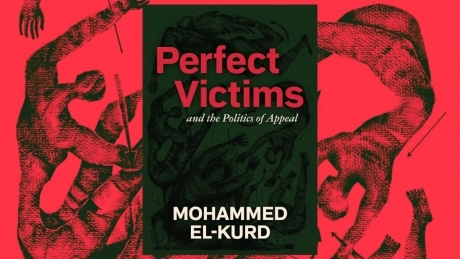
Review: Perfect Victims and the Politics of Appeal – by Mohammed El-Kurd
August 7, 2025
After over a year and a half of bombardment and deprivation of water, food, and shelter, the Israeli state is starving Palestinian people in Gaza to the point of famine.
The US and its allies, including the Canadian state, have provided the material and ideological resources for doing so. In light of these atrocities, Mohammed El-Kurd’s Perfect Victims and the Politics of Appeal (Haymarket, February 2025) may be one of the most powerful and important literary interventions of our time. It invites a candid examination of not only the most extreme anti-Palestinian racism and the thinly veiled, now largely exposed liberal chauvinism of those who claim neutrality. It also queries the work of activists in the global movement for Palestinian resistance itself. Rather than focusing on individual self-examination and morality, though these elements are present, El-Kurd asks supporters of a free Palestine to rethink how to be the most effective in bolstering Palestinians in their urgent fight for their lives and their land.
The effects of both the bad- and good-faith characterizations of Palestinians are combined with accounts of El-Kurd’s life experiences, as well as those of other Palestinian authors, scholars, and artists. The past is brought into dialogue with the unparalleled horrors of the present. The book is filled with playful poetry and prose in both English and Arabic, not always provided in English (“ask your Arabic-speaking friend to translate”). It challenges readers in earnest, and with humility and humour, to “raise the ceiling of what is permissible” as inspired in part by fellow poet Refaat al-Areer, one of the people to whom the book is dedicated. Al-Areer was killed by the Israeli state during the genocide, and elevated into the Western news cycle because he was a reputed poet. El-Kurd asks why it is not enough that he was simply a person.
Like most Palestinians living in the parts of their land divided and ruled by check points, identity cards, and armoured tanks, El-Kurd’s personhood and right to exist on his land were interrogated constantly as a child. When this routine was punctuated by a stranger from Long Island moving into his family’s house in Sheikh Jarrah without their consent, the possibility of an ordinary way of life for an eleven-year-old was extinguished. (Few eleven-year-olds in the modern Canadian state would relate to the indignity of having their family home invaded by entitled settlers from another continent, though Indigenous peoples have lived it through their ancestors and continue to bear the consequences in the present.)
El-Kurd observed and adopted the self-censorship of adults around him in the presence of foreign television cameras or NGO researchers, always eager, as El-Kurd points out, to “see for themselves.” He learned the adjudication of the western gaze and adjusted his behaviour, dress, and language accordingly. The politics of appeal led him to discourage his grandmother from using the word “Jews,” to refer to settlers, even though these were the terms they used for themselves. What motivates a child in Sheikh Jarrah to become an expert, self-taught self-censor is evidently survival and self-preservation under surveillance, occupation, and the violence of an active settler-colony.
El-Kurd calls on readers not to simply debunk the most severe vitriol of Jewish supremacist, self-identified fascist settlers, including those in the Israeli parliament. Nor does he ask us to find new ways to contest Western state and commercial media propaganda on their terms. Rather, he asks us to reconsider whether the colonialist, imperialist constructions built into the most obvious bigotry (and the more insidious form, such as is on full display in Jon Stewart’s recent interview with Peter Beinart on the Daily Show) is also present in the global Palestinian resistance movement. If, he ventures, the racism that makes it possible for such lies to propagate in the first place also underlies the tactics of the most well-intended activists, then the battle is already lost.
Instead, we must consider alternative methods than those that capitalist institutions such as news media, universities, NGOs, think tanks, legal institutions, corporations, philanthropic organizations, and parliamentary parties tend to motivate. Even the most radical movements for a free Palestine (and to this, we can add, even those of us that commit the public relations blasphemy of refusal to “condemn Hamas”) should avoid the traps of credibility and currency that come from those capitalist and state institutions of which we claim to be critical.
On July 28th 2025, several outlets broadcast interviews with a British United Nations spokesperson to inform viewers that Israel is deliberately starving Gaza. A day later, two Israeli human rights organizations declare that this is a genocide. The official institutions of capitalism and imperialist states take several decades to name realities that are in plain sight for Palestinians who have been writing and speaking about their resistance of violence, oppression, colonization, and genocide, since the early 20th century. However, as El-Kurd points out, they are considered too partial to be credible commentators on their own reality. The only instance where a Palestinian can be deferred to on the matter of Palestinian liberation is if they are “defanged.” They must be a perfect victim focusing entirely on their own personal story. They must be a woman, mother, child, grandmother; a doctor, journalist, poet, artist; a Palestinian with wealth, a Palestinian who has integrated in the West, or a scholar. They have a right to speak only if they have illustrated that they do not hate their oppressor before they express, however tentatively, their right to resist their oppression.
The point, for El-Kurd, is that young Palestinian men whose livelihoods have been stolen from them deserve just as much to be treated with humanity and equality. The same goes for people who don’t or can’t use words. And for people who were born in Gaza as a concentration camp. The same applies to a Palestinian man who sees settlers, supported by guns, tear gas, and bulldozers, try to steal his house, and to a young boy who has witnessed the murder of 50 of his family members and is red-hot with raw, righteous rage. In all these circumstances, the right to resist should be asserted, rather than rationalized or explicated, regardless of whether rocks are thrown or shots are fired. Human rights is a phrase without qualifiers.
Such criticisms should not be confused with advocacy for a purely identitarian political movement. People from all faiths, ethnicities, and nationalities must work effectively together to support liberation movements, to counter the way that the ruling classes organize effectively from all backgrounds to oppose such movements. What the criticisms point to is the need to combat the material consequences of active settler-colonialism, as well as rebuffing the racism that makes it possible. It is not always obvious, to those of us habituated to equivocating, how to do this. El-Kurd suggests some tactics he has tried himself, including drawing attention to the language used to obscure facts on the ground. In other cases, dismissal, mockery, or outright refusal to engage may be most appropriate, with the added benefit of catharsis. Direct the spotlight to the claims designed to distract and deflect from actual bombs falling on actual people, and allow their absurdity full visibility.
The core provocation in Perfect Victims is the most essential one we face as we witness the mass murder of a people at a scale that no population of human beings has been subjected to in the twenty-first century. It is not how our words may hurt the feelings of those who support (or aren’t sure where they stand on) this “controversial” issue. As El-Kurd notes, it is not his fault that his oppressors are Jewish. The challenge, rather, is for non-Palestinian comrades to be most useful: first, in putting a stop to the genocide, and second, in providing support for the self-liberation and self-emancipation of the Palestinian people—a goal that is several generations overdue.
It is a call for decolonization (not a metaphor), and perhaps for a justice even greater in scale, which Palestine has led the world closer to than anything else in recent history. In El-Kurd’s words, “The world is changing because it must. If seeds can germinate in the inferno, so can revolution.”
Section:


Featured Event
Events
-
October 4, 2026TorontoOrganized by:International Socialists
Recent Videos


Visit our YouTube Channel for more videos:

Visit our UStream Channel for live videos: