
|
Reports
You are here
London Film Screening Marks the 35th Anniversary of Mohawk Kanehsatà:ke Resistance
July 23, 2025
On July 11, 1990, a 78-day standoff began when the Mohawk of Kanehsatà:ke resisted the violent expansion of a golf course onto their sacred forest and ancestral burial grounds.
Commonly called the “Oka crisis” in settler communities, the siege by Sûreté du Québec (SQ) Quebec provincial police, the Canadian Army and RCMP, marks a “watershed moment”for Indigenous land defense and struggle on Turtle Island.
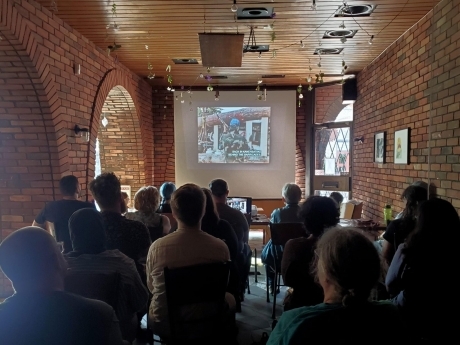
To mark the 35th anniversary, there was a free public screening of Kanehsatake: 270 Years of Resistance(1993, directed by Alanis Obomsawin) on July 10 at DoughEV (621 Dundas Street), co-hosted by London International Socialists, Sabotage Media, and Antler River Media Co-operative.
“After trying to fight the ‘proper’ way for months at that point, they had no choice left after the court was going to allow the development. So, they set up a blockade on the dirt road that was leading into the Pines,” said Cailin Gallinger, member of the International Socialists and organizer of the screening, in her introduction of the film.
The documentary chronicles the fight back against state repression and illustrates important lessons about direct action and Indigenous solidarity for today with the passing of provincial Bill 5 and federal Bill C-5 legislation that violates Treaty rights and the necessity of Indigenous community consultation and consent.
“It gained national attention as this standoff continued. There was support from across Turtle Island from Indigenous nations, but also many other communities arrived in the area to show support for the people of Kanehsatà:ke,” added Gallinger.
Gallinger said she was partially inspired to organize the screening by the recent book When The Pine Needles Fall, by Katsi’tsakwas activist and artist Ellen Gabriel. Gabriel is a Kanehsatà:ke woman who appears throughout the film and was one of the lead negotiators during the siege, as one of the few in the community who spoke English and French in addition to her native Kanienʼkéha (Mohawk).
“The ‘macho man’ narrative that the media tried to foster was an imposed narrative, it was in essence trying to justify the use of force against Indigenous people who have resisted colonial law and authority for many generations,” wrote Gabriel in When the Pine Needles Fall.
“But the gender imbalance, a perspective promoted by the media, also overshadowed the important role that women played in defending the land, in our resistance. It was a very strong role, it’s important that people understand that.”
Although the land defense was successful in preventing the golf course expansion, the lands are still held by the federal government in an ongoing settler colonial violation of Indigenous sovereignty.
Connections to Kill Bill 5 Land Defense
Gallinger described her recent experience at the “Kill Bill 5” action held at Queen’s Park in Toronto on July 1 to oppose Bills 5 and C-5, hosted by Idle No More and two Indigenous youth groups.
These youth, along with Indigenous land defenders from across Turtle Island, established an encampment at Queen’s Park on June 4 after the passage of Bill 5, right before the provincial government’s summer recess. The July 1 “Kill Bill 5” actions were meant to spark a new wave of opposition and resistance to these dangerous bills, and included a youth summit in the morning demonstrating against the cannon-firing and other acts of colonial celebration of so-called “Canada Day”. The afternoon rally opened with a prayer by an Indigenous elder and a drum performance and dance by members of the Okiniwak encampment.
Eve Saint, one of the members of the encampment and a Wet’suwet’en Land Defender, spoke on the connections between the RCMP crackdown on the Wet’suwet’en in 2019 and 2020 to make way for the Coastal GasLink pipeline and the potential for similar state repression under the auspices of Bills 5 and C-5.
The provincial Bill 5 and federal Bill C-5 function to bypass environmental protections, reduce mining and development project oversight and ignore Treaty requirements for First Nations consultation and consent. They have both passed despite objections of Indigenous leaders, environmental activists, labour unions and civil liberties organizations.
“We are deeply moved by the support shown by the London International Socialists,” said Elected Chief Todd Cornelius from the Oneida Nation of the Thames in a letter about the event. “Your presence at the July 1st protest in Queen’s Park, and your ongoing efforts to educate and mobilize through community events such as your film screening, are not only encouraging — they are also powerful acts of allyship in a time when unity is needed more than ever.”
The July 1 rally was a demonstration of solidarity between Indigenous, labour unions, and environmental groups and other allies, but was also marred by an altercation between march attendees and Toronto police. Police lined University Avenue to block protestors from continuing to march.
“Okiniwak and other First Nations drummers, who had been leading the march, moved up to confront the imposing police line and demand they allow us passage, as there was no justification for restricting our movement through public land,” said Gallinger.
“This was met with a show of intimidation and provocation, including the deployment of mounted police units, who charged the front lines and caused march participants to scatter.”
Reflections on the Event
About 20 people attended the screening, with over half staying after the film for a discussion on their takeaways and reactions.
“In an era where reconciliation is so often referenced, the film was a good reminder that the ever present threat of violence exists and who it truly menaces,” said Leif Maitland, a community member who attended the screening.
“I also found in it hope that efforts to prevent land expansion, though subject to massive displays of power, can proceed. It’s also a reminder for those struggling to determine what to do in the face of overwhelming odds that direct action is the method,” Maitland added.
Attendees were encouraged to support Indigenous land defense by working with local Indigenous initiatives to restore or protect native plants, animals, and habitats, or writing letters to MPs and other members of government stating disapproval of legislation that would sidestep Treaty obligations.
“I want to extend a heartfelt Yaw^ko for your message of solidarity, and for standing with us in opposition to Bill C-5 and Bill 5,” said Chief Cornelius in the letter.
“We continue to assert our responsibilities to protect the land and water as instructed by our ancestors. When others rise to uphold the treaties, respect Indigenous sovereignty, and advocate for justice, it reinforces that this struggle is not ours alone — it belongs to all who seek to live in right relation with the land and with one another,” added Chief Cornelius.
“As the government’s efforts to repress opposition to this legislation ramp up, with justifications of opposing economic hardship or fighting for our so-called ‘freedom’ from the tide of rising fascism, we must look to Indigenous leaders and be prepared for more direct confrontations with the realities of colonial violence,” added Gallinger.
*Article was first published in Antler River Media Co-operative (https://antlerrivermedia.ca/)
Section:


Featured Event

Events
-
October 4, 2026TorontoOrganized by:International Socialists
Recent Videos


Visit our YouTube Channel for more videos:

Visit our UStream Channel for live videos: