|
Reports
You are here
Power of the People: 250 million workers strike in India
July 11, 2025
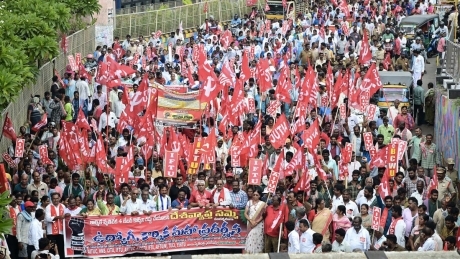
On July 9th, an estimated 250 million workers and farmers took to the streets in India, in defiance of the Modi government, in what was the largest organized working-class action in the country this year. The ‘Bharat Bandh’, which is the name given to national day-long industrial actions, translates to ‘India Shut Down’ – a call to bring the capitalist economy to a standstill.
As workers walked off the job from Kerala to Jammu & Kashmir, Bengal to Punjab, and Bihar to Maharashtra, a wide range of sectors were simultaneously disrupted, including mining, banking, public transport, insurance companies, supermarkets, and parts of the Indian Railways. The actions were militant in many places, with not just road and rail blockades, but also occupations that defied court orders and injunctions.
Repeal the new Labour Codes
This strike was called by the Central Trade Unions (CTU), a coalition platform that represents all the major trade union federations in India. The largest of these federations are CITU, AITUC, and the INTUC and are politically connected to the left and center parties: the Communist Party of India (Marxist), the Communist Party of India, and the Indian National Congress, respectively. On the other hand, the unions allied to the ruling party of BJP, which are much smaller in size, were expectedly absent from the day of action and discouraged their members from participating, calling the strike as ‘illegal’.
This Bharat Bandh, the fourth in a series of national strikes since 2020, was rooted in a specific set of demands, connected to four draconian Labour Codes which were brought into existence by the Modi government in 2020. These labour codes attempt to overhaul the system of industrial relations in India, with a massive attack on basic worker rights, while offering huge concessions to the bosses. The codes provide for a possible increase of working hours up to 12 hours, removal of restrictions on overtime, encouragement for bosses to fill positions with temporary jobs over permanent employment. As well these changes render the directives of the Minimum Wage Advisory Board as non-binding and also make it extremely difficult to organize new workplaces, by altering union recognition guidelines in favour of bosses. Additionally, the labour codes restrict the right to strike by rendering a ‘notice period’ as compulsory across the board, while leaving the time period itself as arbitrary and unspecified. This would make it possible for bosses to ‘legally’ challenge strike actions.
The key demand at the heart of the strike is for these labour codes to be repealed, alongside other demands to end the contracting out of public work (especially in the railways), and the establishment of a national minimum wage of ₹26,000/month (415 CAD). The industrial strike also supported the ongoing demands of the farmers, which include the waiving of loans for debt-ridden farmers, putting a stop to forced land acquisitions, and establishing a minimum support price for all agricultural produce.
Challenging inequality, Islamophobia, and the Billionaire Raj
Since the Modi government came to power in 2014, India has seen a decade of anti-worker policies combined with Islamophobic scapegoating and a deepening of Indian military presence and control over Kashmir. Over this period, income inequalityhas sharply risen in the country which, as a study by the World Inequality Lab shows, is now worse than even the period of British colonial rule in India.
Just in the year 2023, close to 100 new billionaires were created in India, at the same time as the country slipped to the 105th position among nations in the World Hunger Index. During this time, we have seen Tech CEOs, such as Narayana Murthy of Infosys, calling for 14-hour workdays, and the L&T Chairman SN Subrahmanyan chastising workers for spending Sundays at home “staring at their wives”, while they should be working around the clock. While these statements have been publicly ridiculed by the Indian people, they reveal the strong impunity that the Modi government has promised his billionaire cronies.
While Modi takes pride in his claim that India is the ‘fastest growing economy’ in the world, the reality is that this ‘growth’ is a growth of poverty, deprivation and homelessness, which for Muslims in India also means vulnerability to religious violence, expropriation of their properties, and a crackdown on their democratic rights. Over this decade, we have witnessed an incremental intensification of the fascistic tendencies of Modi and the BJP, where state-sanctioned violence – carried out with impunity - has become a cover through which the bosses enrich themselves and keep themselves protected from any unified and mass dissent.
In this moment, even as corporate media ignores the strike action, the Bharat Bandh offers the fleeting vision of a window into a different future that remains possible, one where workers across religious faiths could come together to reject divisive politics and instead take matters into their own hands by grinding the economy to a halt. As the third term of the Modi government has shown itself to be the weakest so far, without a majority to boast of, the window to another world is wider than ever before. Therefore, despite the failures of the electoral opposition to Modi over the last decade, it is the opposition brewing in the streets that can bring hope.
The Strike is Political
While there is often a tendency on the left to look at these single day Bharat Bandhs as purely acts of spectacle or performance, the reality is that these actions can build the foundations for something bigger.
It was Rosa Luxemburg, the Polish German revolutionary, who taught us that it is “absurd” to think of the mass strike as an isolated action, or to separate its economic demands from the underlying political ones. Instead, ‘demonstration strikes’, such as the Bharat Bandh, can play the greatest role in the beginnings of new movements, by helping develop political consciousness and by advancing a sense of seriousness in the class struggle. These are moments in which the working class looks in the mirror and recognizes its own history and its own power. The resistance over the past five years since the introduction of the new labour codes, which includes the four national strikes and Bharat Bandhs, shows that – despite its self-proclaimed omnipotence – the Modi regime can, in fact, be challenged on the streets. After all, among other things, it was the historic farmers’ strike of 2020-21 that brought the Modi majority to its knees, making Modi desperately in need of ‘allies’ in parliament by the next election.
Just as the people of the Indian subcontinent once overthrew the British Raj, it is now time to overthrow the Billionaire Raj.
Section:


Featured Event
Events
-
October 4, 2026TorontoOrganized by:International Socialists
Recent Videos


Visit our YouTube Channel for more videos:

Visit our UStream Channel for live videos: